
The Enneagram & Loneliness
Hidden Patterns That Keep Us Apart—and How to Work with Them
Why This Matters
We live in a time of epidemic loneliness—yet most self-development tools focus on the self, not the space between. Loneliness isn’t just a feeling—it’s a structural feature of personality. Each Enneagram type organizes around a relational wound that once kept the child safe—but now keeps the adult separate. This guide helps you see how each type’s fixation protects—and paradoxically isolates.
The Enneagram, when used skillfully, can help rewire that space. This FREE eBook is for those who want to go beyond type descriptions, and toward healing the relational wound each type was built to protect. It’s not a diagnostic. It’s a doorway.
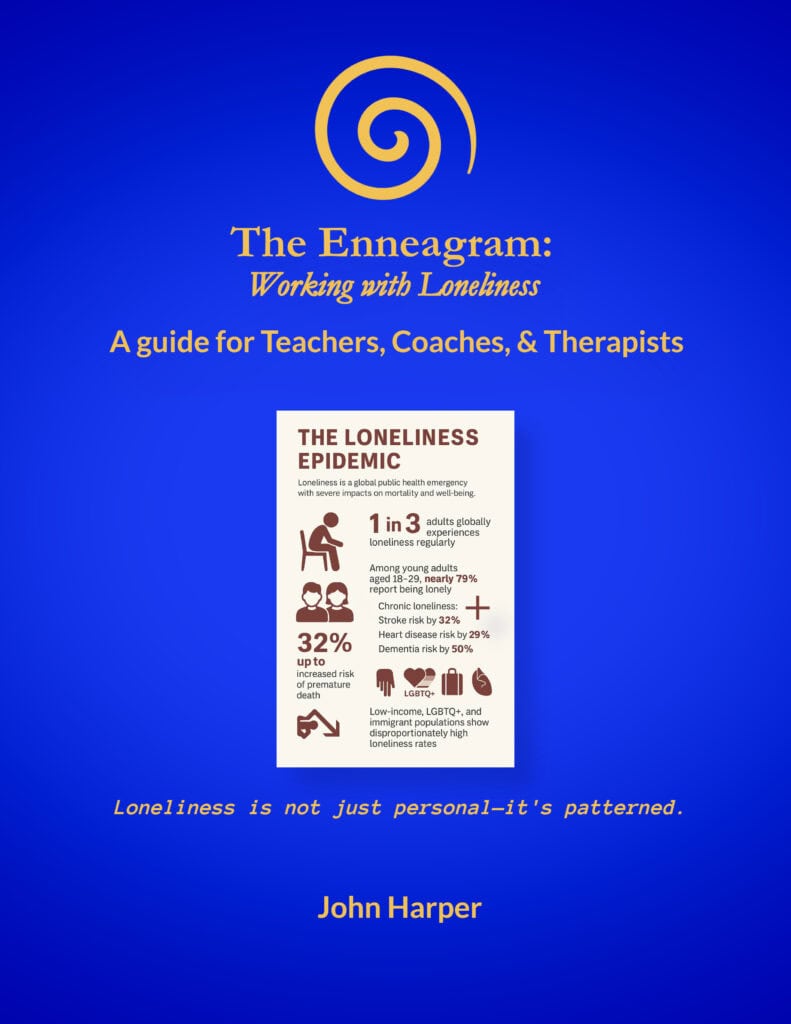
What’s Inside this Free eBook
- The Developmental Roots of Disconnection – Understand how early attachment patterns shape personality—and the loneliness that follows.
- The Loneliness Loop of Each Type (download) – How each fixation cuts off the very thing it longs for most.
- Catch‑22 Mapping Tool (download) – A printable worksheet that reveals the core paradox of each type’s defense strategy.
- Practitioner Insights – Somatic, emotional, and relational keys to support deeper presence and connection.
What Practitioners Gain
- A relational map of each type’s adaptive brilliance and its isolating cost
- Somatic and emotional tools that move clients beyond insight toward felt presence
- A shift from fixing personality to meeting the person beneath it
Loneliness is not a flaw. It’s a structure.
Every Enneagram type carries a hidden architecture of disconnection—shaped in childhood, defended by fixation, and mistaken for identity.
Discover how each type’s strategy perpetuates loneliness—and how you can meet the longing beneath it.
Table of Contents
- Why Loneliness Matters More Than Ever
- The Shape of the Epidemic
- Structural Loneliness – The Developmental Echo
- The Catch-22 of Each Type
- Fixation and the Somatic Loop of Disconnection
- Type-by-Type Breakdown – The Loneliness Loop
- Loneliness and Longing – The Secret Architecture of the Type
- The Role of the Practitioner – From Strategy to Presence
- The Developmental Roots of Loneliness
- Practical Tools for Teachers and Therapists
- Presence Is the Path
- Experiential Work
How It’s Structured
- Tactical Tools – Worksheets, prompts, questions, language and frameworks to support deep work
- Developmental Roots – Tracing fixation back to early relational wounds
- Structural Loneliness – Understanding how adaptation hides and sustains disconnection
- Type Catch‑22s – Exploring how each strategy undermines its own longing
- Somatic Loops – Bringing awareness to how fixation lives in the body
- Longing Maps – Naming what each type truly needs
- Practitioner Presence – Embodying openness so clients can feel met
John Harper is a Diamond Approach® teacher, Enneagram guide, and a student of human development whose work bridges psychology, spirituality, and deep experiential inquiry. He is the author of The Enneagram World of the Child: Nurturing Resilience and Self-Compassion in Early Life and Good Vibrations: Primordial Sounds of Existence, available on Amazon.