
FORCE, DYNAMISM, AND THE BREATH OF BEING
Most contemporary interpretations of the inner Enneagram triangle imagine it as a circuit—subtle energy moving along the lines, tracing a path from Nine to Three to Six and looping endlessly, like a mystical electrical grid. This has become the default picture: a flow, a current, a rotation. But this entire image collapses the moment you turn toward actual phenomenology. The more you observe your inner life directly, the more obvious it becomes that nothing travels around the triangle. There is no rotation, no current, no movement from point to point.
The truth is more straightforward and far more alive: the triangle describes how experience breathes. Every moment is a rising out of the field and a dissolving back into it. Appearance and disappearance. Emergence and recession. The field is the quiet ground of both. These are not energies in motion but forces in expression—different orientations of Being, different dynamisms of consciousness. The inner triangle is not a circuit. It is a lung.
GURDJIEFF, THE HEXAD, AND THE LIVING ENNEAGRAM
This framework not only clarifies the Law of Three but also lays essential groundwork for understanding the hexad and the circle—not as static diagrams but as living processes. The mapping of the three primary object relations onto the triangle further strengthens this foundation, revealing how the earliest relational distortions shape the active, passive, and reconciling forces as they unfold through the system. These integrations are explored in depth in our upcoming book, The Enneagram as Living Process, where the triangle, the circle, and the hexad are reunited as one dynamic intelligence.
THE FIELD (POINT NINE) — THE PRIMORDIAL MEDIUM OF EXPERIENCE
Nine is not a point where something lands. It is the medium in which everything takes place. The field is the ground-state of awareness, the baseline openness from which all phenomena arise. It is presence-before-expression. It is the atmosphere of consciousness, the silent womb of every impression and every event. The field doesn’t move; it allows. It doesn’t push or pull; it permits both.
When unobscured, the field is exquisitely sensitive. It receives without resistance and holds without clinging. This quality of allowing is its essential dynamism. It is not passive; it is receptive. It is the force-state of openness. But, psychologically, the frustrating object relation interferes with this natural receptivity. When a child encounters inconsistent nourishment—sometimes attuned, sometimes absent, sometimes misaligned—the psyche learns to dampen its needs and soften its aliveness before disappointment arrives. The field contracts into numbness, not as an act of laziness but as a survival strategy. Even so, the essential field remains beneath the dulling, waiting to open again.
The field is not an energy reservoir but the very setting of experience. It is the place into which consciousness breathes back after every emergence.
EMERGENCE (POINT THREE) — THE OUTWARD FORCE OF RADIANCE
Point Three marks the force of emergence—the forward thrust of Being into expression. This is radiance in its essential form. Not performance, not identity, not “doing,” but the natural illumination of presence shining into manifestation. Emergence is the exhale of Being. It is spontaneous, effortless, and uncontrived. It flows because Being overflows.
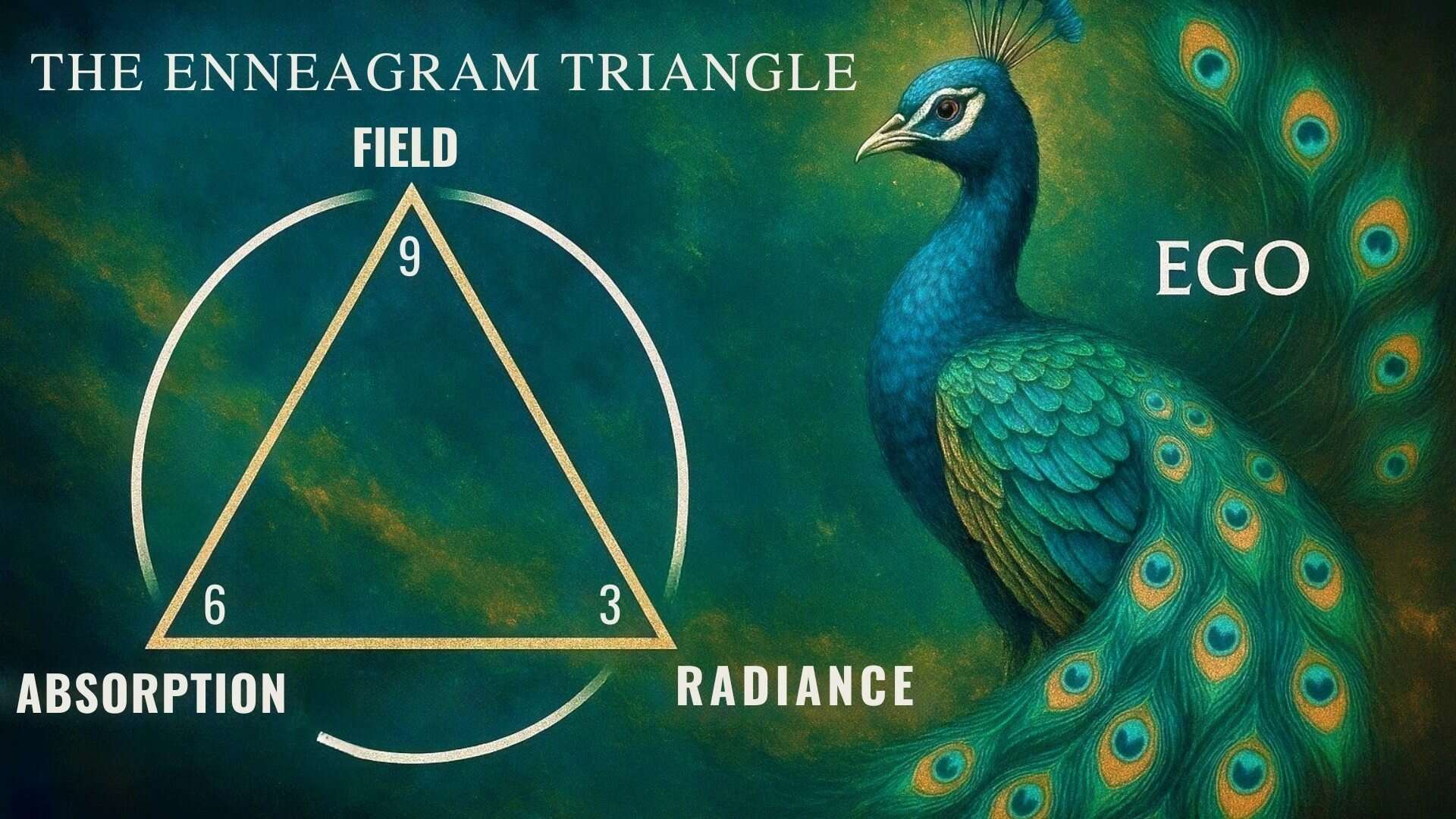
But, again, psychologically, the idealizing object relation distorts this natural radiance. Instead of expressing what is true, the psyche learns to shine in ways that earn approval or secure love. Emergence is rerouted into display. The ego becomes a performer, curating its appearance into a form that pleases the idealized other. This is where the image of the peacock becomes so fitting. In essence, radiance is the sunlight. In ego, radiance becomes the plumage—feathers fanned in a strategic performance.
The peacock does not just glow; it demonstrates glowing. It makes a spectacle of itself. It orchestrates its brilliance. This is the ego’s relationship to emergence: a display in place of radiance, a synthetic shine. The force of emergence remains, but it is dressed, arranged, and stylized to fulfill the demands of the idealized gaze.
Yet even beneath the plumage, the essential dynamism is unbroken. Something still intends to emerge from the field without manipulation. Radiance remains the core movement, waiting for the performance to dissolve.
RECESSION (POINT SIX) — THE INWARD FORCE OF ABSORPTION
If emergence is the exhale, recession is the inhale. The movement at Point Six is the inward force—the return of experience into the field. Absorption is the essential form of this recession, the deep taking-in of reality as it is. Absorption is intimate because it requires allowing experience to penetrate awareness without flinching. It is receptive without collapse, alive without defense.
But, psychologically, the rejecting object relation distorts this inward movement at its root. When a child’s early environment signals that turning toward experience may result in pain, withdrawal, or betrayal, absorption becomes dangerous. The psyche begins to brace against what arises. Instead of recession, there is contraction. Instead of absorption, there is grasping. The ego reaches for reassurance, certainty, and control because it fears the dissolution inherent in returning to the field.
This reveals something extraordinarily important: the ego’s most fundamental activity is rejection. It rejects the now because the now dissolves it. To allow any moment fully is to allow oneself to be absorbed into the field of Being, and ego cannot permit that. Thus, the ego does not merely reject unwanted experiences—it rejects all experiences by either pushing them away or modifying them to avoid dissolution. These are the two basic gestures of egoic life. The ego cannot absorb because absorption would end it. This is why the rejecting object relation is not just a wound; it is the blueprint of the ego’s ongoing posture toward reality.
THE TRIANGLE AS A BREATHING SYSTEM OF FORCES
When you step back and observe the entire structure, the triangle becomes astonishingly clear. It is not a map of movement. It is a map of dynamism. The field allows. Emergence expresses. Recession dissolves. These three forces arise together in every moment of consciousness.
The entire system breathes.
There is no movement from Three to Six. Emergence does not travel to absorption. Recession does not advance toward Nine. Everything arises from the field and returns to the field. The essential pattern is: field → emergence → field → recession → field. A pulsation. A rhythm. A cycle of appearing and disappearing. The triangle is the inhalation and exhalation of experience.
When the forces operate freely, radiance expresses itself without performance, absorption receives without fear, and the field remains open without dulling. When distorted, display constricts emergence, rejection constricts recession, and numbness constricts openness. But in every case, the essential forces remain the underlying truth.
THE OBJECT RELATIONS AS DISTORTIONS OF THE BREATH
Each object relation distorts one of the three forces:
- The idealizing object relation distorts emergence into display.
- The rejecting object relation distorts recession into anxious grasping and perpetual refusal of the now.
- The frustrating object relation distorts the field into numbness and withdrawal.
These distortions are not separate pathologies; they are interruptions in the breath of Being. The ego is simply the set of patterns that prevent emergence, recession, and openness from occurring freely.
THE RELATIONSHIP TO GURDJIEFF’S LAW OF THREE
This entire model aligns seamlessly with Gurdjieff’s Law of Three, though it expresses the forces in a more experiential language. Gurdjieff taught that every event arises through the interplay of three forces: Active, Passive, and Reconciling. These are not energies that flow but modes of action that co-arise. When you map these onto the inner triangle, the correspondence is direct:
- Point Three is the Active Force: the outward movement of emergence.
- Point Six is the Passive Force: the inward movement of reception and dissolution.
- Point Nine is the Reconciling Force: the medium that allows the other two to meet and operate.
In Gurdjieff’s teaching, these forces are cosmic. In the present model, they are phenomenological. Both describe the same reality from different sides. The triangle is not a loop but a triadic event occurring constantly within the field of consciousness.
THE FULL BREATH OF CONSCIOUSNESS
In the final analysis, the triangle expresses the most straightforward truth: consciousness breathes. It emerges, it absorbs, and it rests in the field. When unobstructed, radiance shines without performance, absorption receives without fear, and the field remains open without dimming. When obstructed, emergence becomes display, recession becomes rejection, and the field collapses into numbness. Yet beneath every distortion, the essential breath continues. Emergence. Recession. Field. The living pulse of Being, constantly inhaling and exhaling itself into experience. If you want, we can refine this further, expand individual sections, or integrate a section bridging the triangle with the Law of Seven and the shock points.
John Harper is a Diamond Approach® teacher, Enneagram guide, and lifelong student of human development whose work bridges psychology, spirituality, and deep experiential inquiry. His flagship project, The Inner Architecture Trilogy—Why Study Personality?, The Alchemy of Perception, The Enneagram as Living Process, explores the fundamental structures of consciousness from three interconnected dimensions: perception, process, and vibration.
He is also the author of Nurturing Essence: A Compass for Essential Parenting, The Enneagram World of the Child: Nurturing Resilience and Self-Compassion in Early Life, works that illuminate how essence shapes early psychological development. All titles are available at HarpGnosis and Amazon.