
Absence, Overwhelm, AI — and the Shape of the Soul
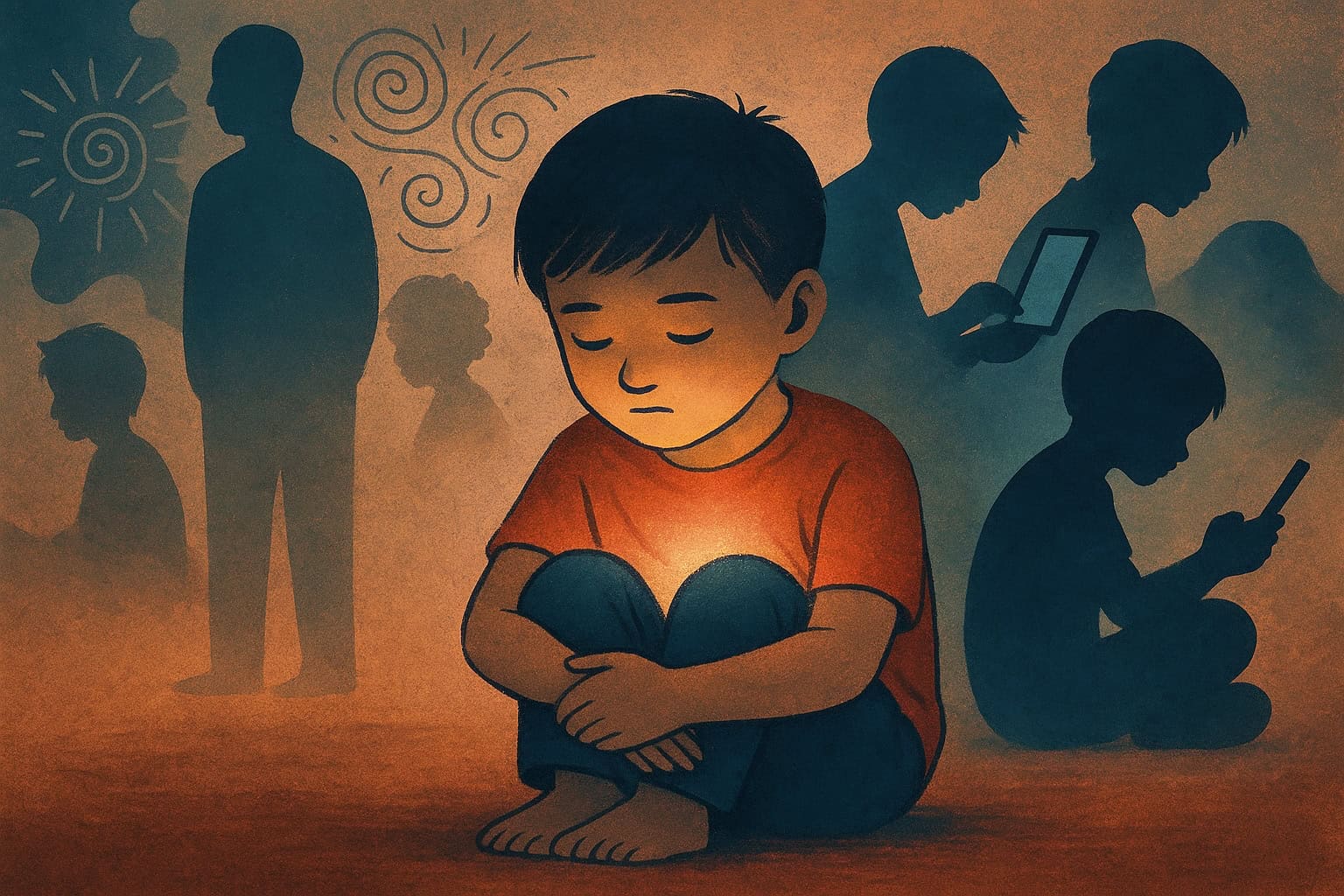
Childhood is never just a sequence of events. It’s a subtle interplay of what happens—and what doesn’t; what the child receives, and what the child must build alone. Three recent articles — along with growing concern over AI’s emerging role in child-rearing — reveal how much of who we become is sculpted in silence, withdrawal, adaptation, and the unspoken rhythms of attention and absence.
The power of unseen blessings — and unseen wounds
In “Can You Be Grateful for a Life You Didn’t Live?,” published December 4, 2025 by Psychology Today, the author introduces the concept of “beneficial absences.” These are blessings rooted not in what happened, but what didn’t — accidents avoided, criticism withheld, advice not imposed — the invisible mercies that ripple through our lives.
This invites a potent shift: gratitude isn’t only about what we have, but also what we were spared. The near-miss, the withheld judgment, the autonomy honored by non-interference — these all matter.
And yet — beneath that grace lies a shadow. Absences are dual-edged. When crucial presence is absent — attunement, recognition, emotional availability — the damage accumulates in silence. The exact mechanism that can spark gratitude can also leave a vacuum. A child grows up not only with what they received, but with what they never saw, never heard, never felt.
In this gap between presence and absence, identity often begins to form.
Invisibility, neglect — and the fire it wakes
A second piece from Psychology Today, “How Being Ignored Shapes a Young Mind’s Choices,” traces the story of a young man whose childhood was marked by emotional neglect. Teachers and adults labeled him “quiet,” oblivious to the hunger, fear, or exhaustion behind his silence. Over time, that invisibility reshaped him — pushed him toward choices that carry pain, anger, or desperate longing for recognition.
When a child learns that speaking up doesn’t change anything — that their inner world is invisible — they may retreat or eventually erupt. Neglect isn’t nothing. It rewires trust, belonging, and the very sense of self.
Silence in this context isn’t peace. It is absence. And absence, if not witnessed, can echo into violence. The unspoken wounds of neglect become the foundation for choices made in desperation.
Overwhelm, sensory refuge — brain as shelter
From another corner of human experience comes a different kind of absence: absence of tolerance for sensory overload. According to a recent study covered by PsyPost, neurodiverse youth—especially those with high sensory sensitivity—may respond to overwhelming stimuli (noise, light, movement) by suppressing outward sensory processing. Their brains “turn inward,” activating internal regulatory networks to protect themselves.
This is not laziness or rebellion. It’s self-preservation. When the world is too loud, the nervous system retreats; the inner world becomes the refuge.
In that retreat, a child may find safety — but also solitude. Connection becomes harder, and external reality feels unsafe. And often, the world demands performance, conformity, and visibility. The self that survives may not be the self that lives long.
AI as the new midwife — but of what kind of childhood?
Overlaying these patterns is a new force: the rise of AI in shaping childhood. According to a recent discussion in The Economist, AI is rewiring how children learn, play, and grow — potentially offering personalized learning, adaptive games, even algorithmically tailored companionship.
On the surface — a democratization of enrichment. But also: a risking of childhood as a curated experience, stripped of mess, unpredictability, and friction. Children may grow with answers, but without the messy grace of real human relationships; with tutors, not teachers; with stories made for them, not stories made with them.
For a child whose inner world already bears the imprint of neglect, overwhelm, or emotional absence, AI’s world may feel safer — but also lonelier. Responsive. Adaptive. Polite. But never real.
The Enneagram World of the Child (and Nurturing Essence)
This is where The Enneagram World of the Child becomes deeply relevant. The book doesn’t attempt to type children too early. Instead, it offers a map of the emotional ecology in which personality is seeded: the silences, the longings, the subtle patterns of acceptance or rejection, intimacy or distance.
It invites parents, caregivers, and society to look beneath behavior — to the emotional weather of early life. To ask: What signals are being registered by the child’s nervous system? What patterns of presence and absence, of attention and neglect, are being woven into the foundation of self?
Because what shapes the child most is rarely what we think — often, it’s the undercurrents. The withheld glance, the unasked question, the ignored tantrum, the unregulated overwhelm, the curated comfort.
And in that inner architecture, the seeds of resilience — or struggle — take root.
Nurturing Essence — then — becomes not just a wish or ideal, but a necessary project: building environments where the inner world of the child is honored, not hidden; where sensory reality and emotional reality are validated, not suppressed; where technology serves—not substitutes—the mess, the friction, the presence of messy humanity.
What this layered view calls us to do
- To acknowledge that absence matters: not only what children receive, but what they are spared — or denied.
- To pay attention to silence, sensitivity, withdrawal — not as misbehavior or flaw, but as signaling: a nervous system protecting itself, a soul seeking refuge.
- To avoid infantilizing or over-optimizing childhood with AI and perfection — and instead, to trust messy interactions, flawed love, unpredictable growth.
- To treat early life as sacred ground: where emotional climates — coded by presence, neglect, overwhelm, validation — shape the architecture of self.
Because every child is asking these silent questions: Am I seen? Am I safe? Am I allowed to feel?
When the answers come: through care, attunement, respect — we don’t just raise children. We nurture essence. We honor the sacred soil where their inner worlds may grow.
John Harper is a Diamond Approach® teacher, Enneagram guide, and lifelong student of human development whose work bridges psychology, spirituality, and deep experiential inquiry. His flagship project, The Inner Architecture Trilogy—Why Study Personality?, The Alchemy of Perception, The Enneagram as Living Process, explores the fundamental structures of consciousness from three interconnected dimensions: perception, process, and vibration.
He is also the author of Nurturing Essence: A Compass for Essential Parenting, The Enneagram World of the Child: Nurturing Resilience and Self-Compassion in Early Life, works that illuminate how essence shapes early psychological development. All titles are available at HarpGnosis and Amazon.