

Why Personality Insight Alone Eventually Stops Working
Seeing More Without Being More
The Enneagram of Personality Types is remarkably effective at revealing patterns. It points to how identity forms, how defenses organize, and how suffering is maintained. For many, this brings real relief and real change. But for those who stay with the work, a quiet frustration often appears: despite increasing clarity, something essential does not move.
This is not a failure of the Enneagram. It is a ceiling built into how it is commonly used.
Insight Can Refine the Loop Without Breaking It
A person can recognize their type instantly, name their reactions as they arise, and even interrupt familiar behaviors. Relationships can improve. Choices can become wiser. Life can function better. And yet, the same internal gravity remains.
From the perspective of the Enneagram as Living Process, most personality work unfolds inside a stalled macro octave. The system becomes more self-aware, but it continues to run mechanically. Presence may appear, sometimes vividly, but without stabilization, it functions as a momentary shock rather than a sustaining force.
The process briefly lifts, then settles back into repetition.
Why This Ceiling Is So Hard to Name
When progress slows, it is often interpreted psychologically: resistance, fear, secondary gain, or unfinished childhood material. While these may be present, the deeper issue is structural rather than personal. The first shock has not become continuous. Without ongoing presence, even sophisticated inner work reorganizes around memory, effort, interpretation, or aspiration. The work continues, but the center of gravity does not shift.
This is why insight can accumulate while being remains largely unchanged.
What the Enneagram of Living Process Adds
The Enneagram of living process, as articulated by George Gurdjieff, introduces a vertical dimension that personality alone cannot supply.
Personality describes the content of experience.
Process reveals the conditions under which experience unfolds.
The first shock point marks the entry of conscious energy. Without it, life proceeds by habit, even when those habits are intelligent, compassionate, and spiritually informed.
When Presence Stabilizes, Type Loses Its Grip
As presence begins to stabilize, the relationship to type changes quietly but fundamentally. Type does not disappear, but it no longer defines the horizon of possibility.
Patterns are seen rather than inhabited.
Fixations arise without dictating action.
Reaction becomes transparent rather than compelling.
The Enneagram stops being a tool for self-management and becomes a way of observing how the self operates when it is no longer running the show.
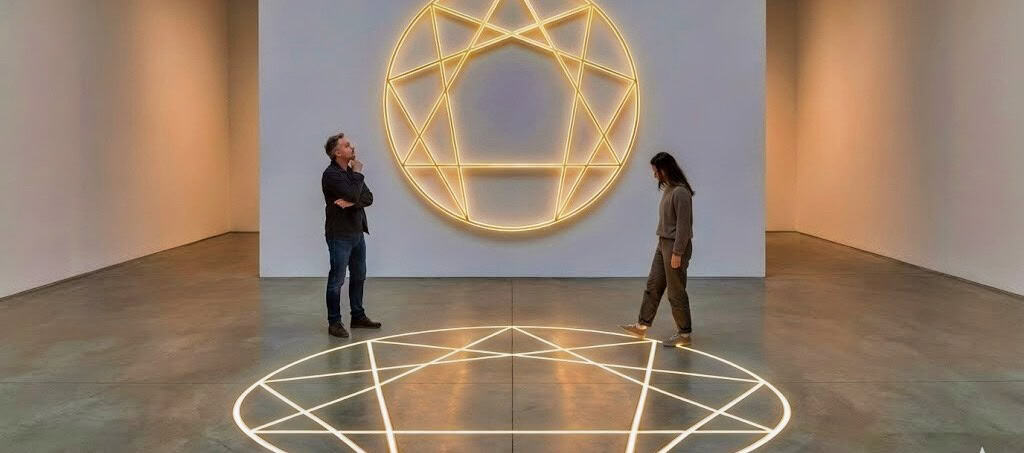
Why the Two Enneagrams Belong Together
The Enneagram of personality shows what repeats.
The Enneagram of process shows why it repeats.
Used together, they reveal that the ceiling many encounter is not a personal limitation but a missing structural element. Insight alone cannot carry the process forward. Presence must become part of the operating system.
Not more understanding.
Not better strategies.
But a different way of participating in one’s life.
John Harper is a Diamond Approach® teacher, Enneagram guide, and lifelong student of human development whose work bridges psychology, spirituality, and deep experiential inquiry. His flagship project, The Inner Architecture Trilogy—Why Study Personality?, The Alchemy of Perception, The Enneagram as Living Process, explores the fundamental structures of consciousness from three interconnected dimensions: perception, process, and vibration.
He is also the author of Nurturing Essence: A Compass for Essential Parenting, The Enneagram World of the Child: Nurturing Resilience and Self-Compassion in Early Life, works that illuminate how essence shapes early psychological development. All titles are available on Amazon.