
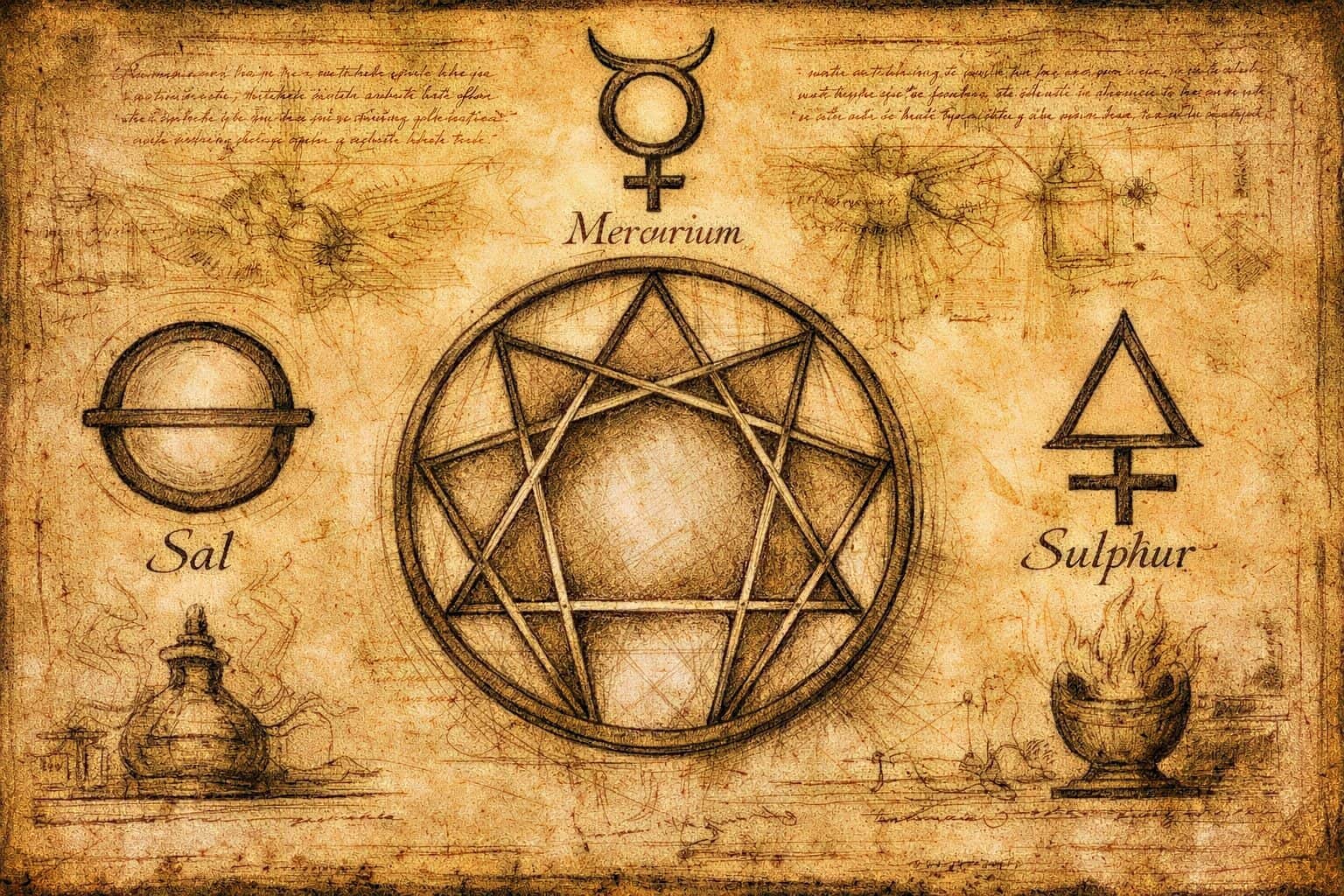
Reading the Symbol Through Almaas and the Inner Architecture Trilogy
The Enneagram reveals its deepest logic when read alchemically. The inner triangle functions as Mercury, the hexadic movement as Sulfur, and the enclosing circle as Salt. This is not an imposed metaphor. It is a recognition of how the symbol already operates as a transformational system rather than a personality map.
When approached this way, the Enneagram describes how reality organizes, destabilizes, and re-embodies itself through human experience.
Substance and Principle in Classical Alchemy
It is essential to be precise about what classical alchemy actually was. Early and classical alchemy absolutely worked with substances. Mercury was mercury. Sulfur was sulfur. Salt was salt. Alchemists handled minerals, metals, acids, and compounds in furnaces and vessels. This was laboratory work grounded in matter.
At the same time, classical alchemy did not stop at substance. Through long observation of how matter behaved under transformation, alchemists discerned deeper organizing realities. Mercury, Sulfur, and Salt came to be known as principles because they described patterns that substances alone could not explain.
Classical alchemy did not replace substances with abstractions. It discovered principles through substances. This layered understanding is essential for reading the Enneagram alchemically. The symbol does not point away from lived experience. It points into it, revealing how intelligence, fire, and embodiment operate simultaneously in matter, psyche, and consciousness.
The Alchemical Triad and the Enneagram
In classical Western alchemy, Salt, Mercury, and Sulphur together are known as the Tria Prima, the three prime principles of transformation. Mercury names mediation, volatility, and intelligence. Sulphur names fire, drive, and energetic momentum. Salt names fixation, embodiment, and coherence. The Enneagram expresses these same principles structurally:
- The triangle introduces intelligence, timing, and interruption.
- The hexad expresses drive, effort, and momentum.
- The circle provides containment, embodiment, and field coherence.
Remove any one of these and the system either freezes, burns out, or dissipates.
The Triangle as Mercury
The inner triangle of the Enneagram governs circulation, disruption, and nonlinearity. It is what prevents the system from becoming mechanical. The triangle does not add energy, and it does not stabilize form. It introduces intelligence. Mercury operates sideways. It intervenes rather than pushes. It reorganizes perception rather than increasing effort. In lived experience, this appears as insight, reorientation, or sudden recognition that cannot be produced through will.
This is why the triangle governs the shock points. Without Mercury, the system repeats itself endlessly. With Mercury, transformation becomes possible.
The Hexad as Sulfur
The six-pointed flow of the Enneagram is the engine of becoming. It is movement, striving, adaptation, and desire. This is the realm of personality, development, and effort. Sulphur is not a problem to be eliminated. It is the fire that animates all movement. But fire alone cannot complete the work. Sulphur without Mercury burns without understanding. Sulphur without Salt consumes the very vessel meant to hold it.
In the alchemical sense, the hexadic movement expresses Sulphur as raw vitality and momentum. When intelligence intervenes and embodiment can truly contain the process, that same fire reveals a different quality. It is no longer blind striving but a living combustion aligned with reality itself, what the alchemists called red sulphur.
Much Enneagram teaching remains stalled at the level of managing or refining Sulphur, mistaking improved momentum or insight for transformation itself.
The Circle as Salt
The enclosing circle is not decorative. It is the alchemical vessel. Salt is embodiment, density, and coherence. It is what allows transformation to occur in life rather than only in insight. Without Salt, realization becomes abstract. Insight evaporates. Fire becomes destructive.
The circle represents the body, the nervous system, the immediacy of lived experience. Transformation that does not pass through Salt does not last.
Almaas and the Philosophers’ Stone
In The Alchemy of Freedom by A. H. Almaas, alchemy is not treated symbolically but phenomenologically. The philosopher’s stone is described as True Nature itself, self-illuminating and self-transforming.
Almaas emphasizes that realization does not occur through effort alone. It occurs when True Nature activates itself within the human laboratory. This activation is intelligent, non-linear, and self-guiding. It corresponds directly to Mercury functioning within Salt, igniting Sulfur without being consumed.
From this view, transformation is not something the self does.
It is something reality does through the self.
The Inner Architecture Trilogy as an Alchemical Arc
The Inner Architecture Trilogy traces this same movement experientially:
- Why Study Personality? exposes the structure and momentum of Sulfur.
- The Alchemy of Perception introduces Mercury, showing how perception itself mediates reality.
- The Enneagram as Living Process reveals the full system as a dynamic field rather than a typology.
Taken together, the trilogy moves from structure to perception to lived process. Personality is not fixed or repaired. It is metabolized.
The Shock Points as Mercury Events
The two shock points in the Enneagram occur where Sulfur’s momentum exceeds Salt’s capacity to hold it. Effort accelerates. Orientation collapses. At these points, Mercury must intervene, not as technique, but as intelligence. Insight appears. Perception reorganizes.
This intelligence is not the intellect rearranging its ideas. It is the intrinsic knowingness of reality recognizing itself and shifting course from within. No amount of thinking can produce this. It arrives as a change of orientation, not a conclusion. The system continues without burning out or fragmenting. This is why presence cannot be replaced by effort, and embodiment cannot substitute for insight.
Embodiment on its own stabilizes experience but does not redirect it. The body can hold intensity, but it cannot by itself change the direction of the fire that fuels that intensity. Without new understanding, the same patterns continue, only more grounded. Sulphur still burns, just more efficiently.
Embodiment gives transformation a place to land.
Insight shows transformation where to go.
Both are necessary. But only intelligence (awareness, presence) can recognize when the current trajectory no longer serves the unfolding. Only Mercury can reorient Sulphur so that embodiment becomes deepening rather than merely endurance.
This is why embodiment cannot substitute for insight. The vessel can hold the fire, but it cannot guide it. Seen alchemically, the Enneagram is not a map of people. It is a diagram of how reality transforms itself through intelligence, fire, and form.
Mercury mediates.
Sulfur burns.
Salt holds.
The work is not to perfect any one element, but to allow the system to function as a whole.
The question is no longer who you are.
The question is whether you are willing to become the vessel
through which the process completes itself.
John Harper is a Diamond Approach® teacher, Enneagram guide, and lifelong student of human development whose work bridges psychology, spirituality, and deep experiential inquiry. His flagship project, The Inner Architecture Trilogy—Why Study Personality?, The Alchemy of Perception, The Enneagram as Living Process, explores the fundamental structures of consciousness across three interconnected dimensions: perception, process, and vibration.