
Participation, Identity, and the Recovery of Being in the Arc of Transformation
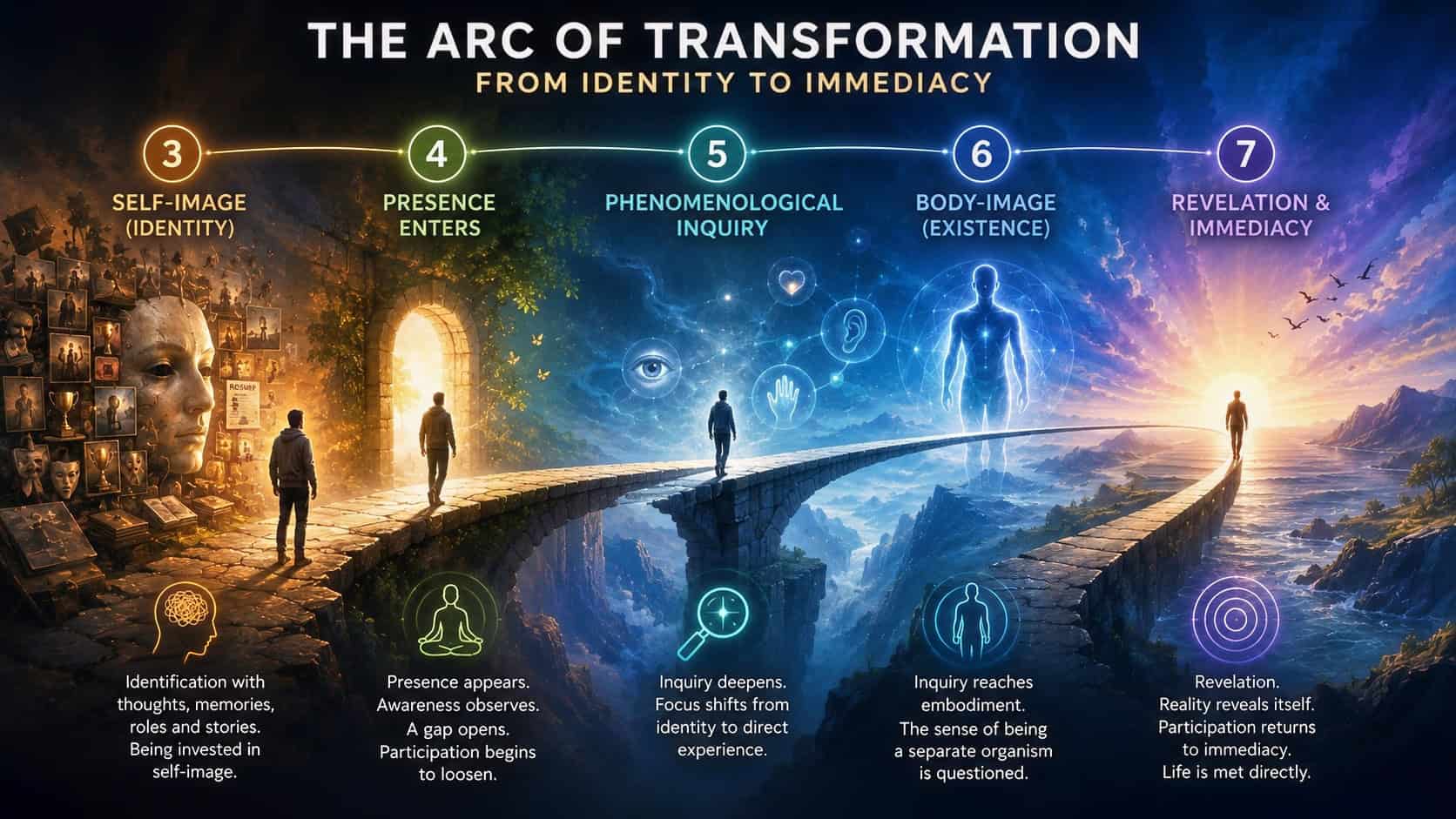
Following my recent lecture on The Arc of Transformation, the second shock point generated the most questions.
Most attendees intuitively grasped the first shock. The idea that presence enters the process between Points Three and Four is relatively accessible. Most people have experienced moments when awareness appears amidst ordinary life. They have tasted moments when they are no longer completely identified with thoughts, emotions, reactions, and stories.
The second shock point proved a bit more challenging.
- How does Point Three reappear at the second shock?
- What exactly is happening between Six and Seven?
- Why does the process seem to change character so dramatically at this stage?
The more I reflected on the discussion, the more I realized that the difficulty may stem from how we typically think about transformation. Most models of transformation focus on changing the contents of experience.
Changing thoughts, beliefs, emotions, behaviors, self-concepts, etc. Yet from the perspective of the Arc of Transformation, something deeper is occurring: Transformation is fundamentally about participation.
More specifically, transformation concerns where being participates and where reality is invested. The two shock points mark major shifts in that participation.
The Hidden Meaning of Self-Image
The journey begins at Point Three, traditionally associated with self-image.
The phrase self-image is often misunderstood. Most people hear the term and think of a mental picture, a collection of beliefs, or a personal narrative. From a transformational perspective, self-image is far more comprehensive than this.
A.H. Almaas describes self-image as the total constellation of concepts, impressions, memories, emotional associations, and boundaries through which we know ourselves. It is not merely an idea about who we are. It is the entire conceptual framework through which identity is organized.
Self-image develops gradually through the accumulation of experience. Every pleasure, disappointment, success, failure, fear, hope, relationship, bodily sensation, and emotional reaction leaves an impression upon the soul. Over time these impressions become organized into representations. These representations eventually fuse into a coherent sense of self.
The self-image is the sum total of all the self-representations.
A.H. Almaas
One of Almaas’ most important observations is that ordinary identity is fundamentally identification with these representations. We do not experience ourselves directly; we experience ourselves through a constellation of remembered impressions, concepts, associations, and forms that have accumulated over time. The self-image, therefore, functions less as a reflection of reality and more as a representation of reality.
What emerges is not simply an image of ourselves but an entire world of self-recognition. This world includes our thoughts, emotions, memories, personal history, aspirations, fears, relationships, values, beliefs, assumptions, and even our sense of embodiment. It includes the subtle familiarity of being this particular person living this particular life.
When we wake up in the morning, there is an immediate recognition: “This is me.” That recognition emerges from the total field of self-image.
In ordinary experience, we do not merely possess this self-image; we experience ourselves through it. It becomes the lens through which reality is interpreted and the boundary through which experience is organized.
The crucial point is that self-image is not a direct experience of ourselves; it’s a representation of ourselves, a living accumulation of the past that continually shapes the present.
This insight becomes essential for understanding the first shock point. Presence does not simply reveal thoughts, emotions, or memories; it begins revealing the entire representational system through which we have come to know ourselves.
The Two Movements of Identification
To understand what happens next, we must introduce another dimension of the process. The soul—or what might be called the medium of experience—is extraordinarily impressionable. Life continually leaves impressions upon it. Every interaction, emotional experience, relationship, success, disappointment, trauma, moment of love, moment of fear, moment of shame, and moment of belonging leaves traces.
Over time, these traces accumulate. Impressions organize themselves into patterns. Patterns become structures. Structures become identity.
Many psychological models stop here. They describe how experience conditions the individual. This is certainly true, yet it tells only half the story. The soul is not merely receiving impressions; the soul is participating in them.
Identification is often described as though it were passive. Experience happens, impressions are received, and identity forms. The story appears complete, yet something essential is missing.
An impression alone does not create identification; participation creates identification. Consciousness enters into relationship with the impression. Being invests itself in the impression. Reality is assigned to the impression.
The soul receives the imprint, then imbues reality into the imprint. The soul receives the image, then says:
- “This is me.”
- “This is what I am.”
- “This is real.”
Without this second movement, identification cannot stabilize.
- The impression provides the form, Being provides the reality.
- The impression provides the structure, consciousness provides the investment.
This is why transformation is not merely about understanding impressions; it’s about understanding participation.
- The central question is not simply: “What happened to me?”
- The deeper question is: “What have I invested myself in?”
Cathexis and the Investment of Being
Psychology uses the term cathexis to describe investment. Traditionally, it refers to the allocation of psychic energy toward an object, image, person, or idea.
Viewed through the lens of transformation, cathexis can be understood more deeply as the investment of Being itself.
- The self-image appears real because being has been invested in it.
- The body-image appears real because being has been invested in it.
- The personality appears substantial because consciousness continually participates in its reality.
This investment is rarely conscious, yet it shapes every moment of experience. The result is the conviction: “I am this.” The shock points reveal where that investment has been placed.
The First Shock Point
The first shock occurs between Three and Four. At this point, presence enters the process. Awareness appears, observation becomes possible, and a gap emerges. For the first time, self-image can be observed, not merely thoughts or emotions, but the entire structure, the whole field of self-recognition.
This is why the first shock is far more radical than it initially appears. Presence is not observing a few beliefs; it’s confronting an entire world, a world that has been carrying our investment of Being for decades. The shock occurs because something unexpected becomes visible, our participation.
We begin noticing how consciousness continually reinforces identity, how reality is continually assigned, and how our beingness continually flows into self-image. The first shock does not immediately remove this investment; it reveals it, and that revelation changes everything.
The Journey Into Phenomenology
As the process unfolds from Three toward Six, attention gradually shifts. Identity becomes less interesting, experience becomes more interesting. The question changes.
Instead of asking: “Who am I?”
The inquiry becomes: “What is actually happening?”
This is the emergence of phenomenology. Phenomenology concerns direct experience, not theories about experience, not explanations of experience; experience itself. The individual becomes increasingly interested in the immediacy of experience rather than the stories surrounding it. This is a natural consequence of disinvestment, a de-cathexis.
As participation loosens from self-image, attention becomes available for reality, and the person begins discovering something remarkable: most of life has been spent participating in interpretations of reality, very little time has been spent participating directly in reality itself.
Point Six and the Question of Ontology
By the time the process reaches Six, something profound has happened: the familiar structures of self-recognition have become increasingly transparent. The answer to the question “Who am I?” no longer carries the certainty it once did.
A deeper question emerges: “What am I?”
This question is fundamentally different from the question that organized the first half of the arc:
- “Who am I?” assumes identity. — “What am I?” questions identity.
- “Who am I?” assumes a self. — “What am I?” investigates the nature of that self.
The first question is psychological; the second is ontological. The first seeks greater understanding of the person; the second seeks greater understanding of existence itself.
The movement from Three to Six gradually shifts the center of gravity from identity toward direct experience. Phenomenology becomes increasingly important because inquiry is no longer primarily interested in what we believe ourselves to be. The inquiry becomes interested in what is actually present:
- What is awareness?
- What is consciousness?
- What is experience?
- What is this sense of existence?
- What is this phenomenon I call myself?
The movement toward Six is therefore a movement from psychology toward phenomenology, and from phenomenology toward ontology. Phenomenology investigates experience, ontology investigates being.
- Phenomenology asks: “What is occurring?”
- Ontology asks: “What is this?”
At Three, identity is organized around self-recognition, at Six, identity begins confronting existence directly. The certainty that once supported identity begins dissolving, not because something has gone wrong, but because reality is being encountered more directly.
The Necessity of Space
The emergence of space at Point Six is not accidental; it serves a crucial function within the transformational process.
The movement from Three to Six gradually reveals the constructed nature of self-image. Thoughts, emotions, memories, roles, beliefs, and self-concepts become increasingly recognizable as contents of experience rather than the source of experience itself. As participation loosens from these structures, awareness is no longer completely occupied by the ongoing task of maintaining the experience of being someone.
What appears is space.
This space is not something that is created; it’s what becomes visible when identification begins to relax. Its function is essential. Without space, every experience is immediately appropriated by the existing structure of self and incorporated into the ongoing narrative of “me.” Space interrupts this automatic process; it allows experience to appear before it is organized into identity.
What becomes transparent is not merely the content of self-image, but the forms through which experience has been organized. Thoughts, memories, beliefs, identities, and emotional patterns appear less as enduring realities and more as transient forms arising within consciousness. They continue to serve important functions, yet they are no longer experienced as possessing independent existence. Space reveals their fluid and ephemeral nature. What once appeared solid begins to reveal itself as a continuous process of forms arising and dissolving.
The apparent solidity of these forms does not arise from their permanence; it arises from the investment of Being that has been placed within them. Consciousness lends reality to thoughts, identities, memories, and perceptions, and in doing so, they appear more substantial than they actually are. As space emerges, that investment becomes increasingly visible. What is revealed is not merely the forms themselves, but our participation in their reality.
In this sense, space does not dissolve ego; it reveals that what we call ego is an ongoing activity of form-making within experience. The forms remain, but they are no longer mistaken for something permanent or ultimately real.
Only within such openness can a deeper possibility emerge. The question is no longer merely, “Who am I?” The question becomes, “What is this?” Space creates the conditions for ontology to arise.
The second shock depends upon this openness. Without space, revelation has nowhere to enter. Without receptivity, manifestation has nowhere to appear. The openness of Six creates the conditions through which the revelatory force of Three can disclose a deeper dimension of reality.
Space is therefore not the destination; it’s the threshold.
The Hidden Meaning of Body-Image
If Three concerns self-image, Six concerns body-image.
Body-image should be understood just as broadly. It is not merely an image of the body; it is the total experiential sense of being a separate organism. It includes localization, boundary, and embodiment, the feeling that awareness exists inside a body, the assumption that consciousness belongs to an organism, the certainty that “I am this.”
Just as self-image organizes psychological identity, body-image organizes ontological identity.
Self-image answers: “Who am I?” — Body-image answers: “What am I?”
The first shock loosens investment in self-image, the second shock loosens investment in body-image.
The Conviction of Being a Separate Self
Self-image and body-image appear distinct, yet together they create something more fundamental than either one alone: the conviction that there is a separate, independent entity at the center of experience. The Arc of Transformation gradually reveals that what we call “self” is an ongoing organization of experience rather than an independently existing entity. The distinction is subtle but profound. The issue is not whether the organization exists; it’s whether the organization is what we fundamentally are.
This is where the process moves beyond psychology and into ontology. The issue is no longer simply the contents of self-image. The issue becomes the very assumption of separateness.
- What if the feeling of being a separate self is not the same thing as being a separate self?
- What if the experience of separateness is itself another appearance within consciousness, another phenomenon available to observation?
This is where participation becomes so important. The separate self appears substantial because Being continually participates in its reality. Consciousness continuously invests itself in the experience of separateness. Being lends its reality to self-image, body-image, memory, history, and the sense of individuality. The investment creates the appearance of solidity, while participation creates the appearance of independence.
The first shock begins loosening participation from self-image. The second begins loosening participation from body-image and from the conviction of separateness that both self-image and body-image support.
What is being challenged is no longer merely the answer to the question “Who am I?” The process is now questioning the assumption that there is a separate entity in the first place.
This is why the deepest question beneath the Arc of Transformation is not, “Am I my thoughts?” or, “Am I my emotions?” or even, “Am I my body?” Those are important questions, but they are not the final ones. The deepest question is whether the separate, independent entity we take ourselves to be can be found in direct experience.
By the time the process approaches the second shock point, this question is no longer philosophical; it becomes phenomenological, immediate, and experiential.
- The inquiry is no longer, “Do I believe I am separate?”
- The inquiry becomes, “Can I actually find this separate entity in my experience right now?”
That question sits quietly beneath the entire Arc of Transformation. The first shock point begins exposing the structures that support the conviction of separateness. The second shock point begins exposing the deeper investment that gives those structures their sense of reality. Together, they reveal that transformation is not merely about becoming a better version of ourselves; it’s about examining the very assumptions upon which the experience of selfhood rests and discovering what remains when our participation is gradually withdrawn from the images, concepts, and structures into which we have unconsciously invested our being.
The Second Shock Point
This is where the second shock becomes understandable. The first shock reveals our participation in self-image; the second, in body-image. The first reveals where being has been invested psychologically, the second reveals where being has been invested ontologically.
At Six, openness, receptivity, and not-knowing develop; space emerges, yet openness alone is not enough, something must enter. This is where Point Three reappears, not as achievement, as image, or personality; Three enters as manifestation itself, as revelation, as the force through which being discloses itself.
The openness of Six encounters the revelatory force of Three. Reality begins to reveal its nature, the mystery begins to speak, and Being begins to recognize itself directly rather than through the intermediaries of self-image and body-image.
At this stage of the process, surrender becomes increasingly important. Yet this is precisely where a common misunderstanding arises. The continuation of the arc requires surrender, but surrender is not something the self can successfully accomplish through effort. The very structures that are becoming transparent at Six are the structures through which personal agency has been organized. The self-image cannot surrender itself. The body-image cannot surrender itself. The separate self cannot perform an act that results in its own transcendence.
This is why genuine surrender is rarely experienced as a doing; it’s not an achievement, a strategy, or a spiritual accomplishment. More often it is experienced as grace. Something relaxes, lets go, and gives way. The shift is often recognized only after it has occurred.
Grace does not always arrive dramatically. There is another, subtler way it often enters the process, so naturally that it frequently goes unnoticed.
As identification continues to loosen, space begins to emerge. In the language of the Diamond Approach, this space is often experienced as a hole, an absence where something familiar once seemed to exist. Initially, the self-image interprets this absence as a deficiency, loss, emptiness, or something threatening. Yet when the individual remains present and curious, something unexpected is frequently discovered. The space is peaceful, open, not deficient, not threatening – the space is simply space, open, peaceful, and far less threatening than the imagined self-image.
As this recognition deepens, the organism begins to relax naturally. There is no deliberate act of surrender; there is no spiritual heroism. There is simply the discovery that the space requires no defense.
And then, quite often, a quality of True Nature begins to emerge from the very space that previously appeared empty.
- Strength may arise.
- Peace may arise.
- Love may arise.
- Compassion may arise.
The hole reveals itself to be not an absence of reality, but an absence of contact with a dimension of Being that had been obscured by identification. This too is grace, not because something has been given from outside the process, but because something essential has revealed itself that was never produced by the self in the first place.
Nothing has been manufactured by the self, nothing has been achieved through effort. The individual simply remains present with what is here and discovers that reality is kinder than the self-image expected. The relaxation that follows creates the conditions for Being to reveal itself.
This is one of the deepest functions of the openness that emerges at Six. The spaciousness does not merely expose the limitations of self-image; it creates the conditions through which the qualities of True Nature can reveal themselves directly. What appeared at first as emptiness gradually discloses itself as fullness. What appeared to be a deficiency becomes a doorway. What appeared to be a loss becomes a revelation, preparing the ground for a deeper participation in reality itself.
The first shock reveals where participation has been invested in self-image; the second, in body-image and in the assumption of separateness.
What begins loosening is not merely identification with a story; it’s identification with being a localized entity. The investment (cathexis) is gradually shifting away from the structures through which identity has been organized back toward the immediacy of experience. This shift marks the beginning of a fundamentally different mode of participation.
Participation in Immediacy
The Arc of Transformation ultimately redirects participation itself. At the beginning of the process, participation is invested in representations: self-image, body-image, memory, narrative, concept, and identity.
The shock points gradually loosen this investment to liberate participation. The endpoint is not detachment; the endpoint is direct participation. Participation in immediacy and presence, participation in reality as it unfolds now.
- No longer participating primarily in the story.
- No longer participating primarily in the image.
- No longer participating primarily in the structure.
Participating in the living reality of experience.
This may be the deepest significance of the Arc of Transformation; it’s not fundamentally a process of self-improvement; it’s a process of discovering where being has been invested and recovering that investment from the structures through which identity has been organized.
The first shock begins loosening participation from self-image; the second shock begins loosening participation from body-image and from the conviction of separateness itself.
What remains is not detachment from life, but direct participation in life.
Reality meets itself in the immediacy of experience.