
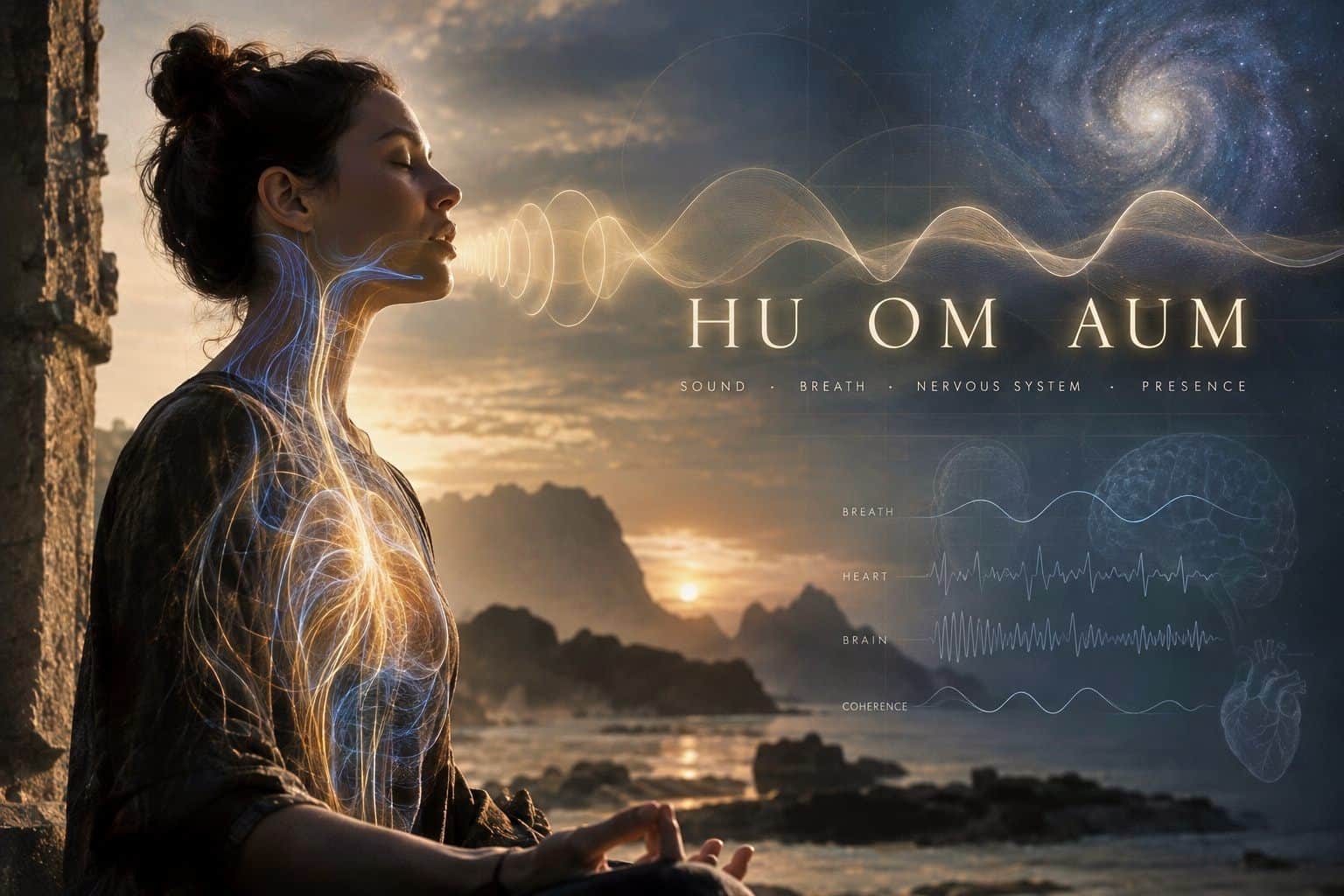
How chanting organizes breath, vibration, attention, and the possibility of a gap
Chanting feels almost primitive. You take a breath, make a sound, feel the vibration, listen to it, and then do it again. Long before anyone knew anything about the autonomic nervous system, vagal tone, respiratory sinus arrhythmia, or brain imaging, human beings had already discovered that sustained sound changes experience. That interests me because it raises a very simple question: what were they actually discovering?
We tend to inherit practices together with their explanations. One tradition says a sound opens a particular center, another says it invokes a divine name, another treats the vibration as sacred in its own right. I have no interest in flattening those distinctions, but beneath the explanations, a human organism is still breathing, vibrating, listening, sensing, and being affected by what it is doing. That is enough to begin with.
HU, OM, and AUM each work with this basic fact in slightly different ways. HU rides the exhalation and can be felt as a broad vibration through the chest, throat, head, or sometimes much of the body. OM changes character as the sound closes into the M, moving from an open vocal sound into humming. AUM stretches that progression further; the mouth and vocal tract change shape as the sound moves from A to U to M, and the vibration quality changes with it.
You can read explanations about this all day, or you can sit down and try it. The body is quite willing to participate in the research, and it quickly becomes obvious that chanting affects more than one thing. Breath changes, attention changes, muscular tension changes, the felt sense of the body changes, and the auditory field changes at the same time. Instead of attention bouncing between thought, memory, planning, sensation, irritation, curiosity, and whatever your phone is doing to your nervous system, experience begins to organize around a repeated event.
Rhythm and Entrainment
There is a useful word for part of this: entrainment. Rhythmic systems influence one another. We see this everywhere in nature and physics, and in ordinary human life. People walking together fall into step, musicians find a common pulse, breathing changes in conversation, and a room full of people can become quiet together before anyone has consciously decided that quiet is what should happen.
The human body is already rhythmic. Breath rises and falls, the heart speeds up and slows down, blood pressure oscillates, attention contracts and expands, and the nervous system continually adjusts to what is happening. Chanting introduces another rhythm into this field, except this one is deliberate, repetitive, and largely predictable.
That predictability matters because the nervous system is constantly asking some version of, What happens next? It has good reason to ask. Survival depends upon prediction. A shift in another person’s face, a sudden movement, an unexpected sound, an unfinished thought, a memory, or a phone notification can recruit attention and produce an adjustment before we have consciously decided anything.
Chanting simplifies the field. The next sound is not a surprise because we are producing it; the breath begins to follow a rhythm, vocalization follows the breath, hearing follows vocalization, and attention can begin settling into the whole event rather than continually searching for the next thing. This can be deeply regulating, but it is also where an important distinction needs to be made.
Regulation and Presence
A calm nervous system can still be entirely organized around the psychological self. We can become relaxed, centered, peaceful, spacious, and quite pleased with ourselves for having become relaxed, centered, peaceful, and spacious. Ego is remarkably adaptable. Give it incense, a cushion, a mantra, and twenty minutes, and it can have a whole spiritual identity up and running before lunch.
The fact that a practice regulates us does not diminish its value. Regulation is valuable, and a nervous system that is less agitated is often more available to subtle experience. Confusion begins when we take calmness, pleasant vibration, concentration, emotional openness, or reduced mental chatter for Presence.
Presence has another quality. It carries immediacy, the simple fact of here and now before the mind has finished turning experience into a story about the person having the experience. This is where chanting becomes much more interesting to me, because its value may have less to do with producing a special state and more to do with interrupting the continuity of ordinary psychological activity.
The Psychological Self and Continuity
The psychological self depends upon continuity. Something happens, and almost immediately we compare it with something that has happened before. We decide what it means, how we feel about it, whether we like it, what it says about us, what it says about somebody else, and what we should do next. Memory, anticipation, interpretation, evaluation, and response weave together so quickly that we rarely notice the weaving. We experience the finished fabric and call it me.
Chanting occupies some of the machinery that normally keeps this fabric moving. Breath is engaged, hearing is engaged, vocalization is engaged, sensation is engaged, and attention is increasingly drawn toward something immediate and repetitive. The psychological process doesn’t necessarily disappear, but it can lose some momentum, and sometimes that is enough.
The chant does not have to destroy the ego, transcend personality, open the seventh chakra, activate ancient DNA, or accomplish any of the other heroic assignments humans have given sacred sound. It may simply interrupt us long enough for another possibility to appear.
AUM and the Gap
The most interesting part of AUM may not be A, U, or M. It may be what happens after M, because the sound ends and a brief interval follows before the next sound begins. We usually think of that interval as dead space, a pause between repetitions, but I suspect it deserves much more attention.
During the chant, the organism gathers around a coherent event. Breath, sound, vibration, hearing, and attention move together. Then suddenly the event is gone. Nothing remains to sustain, nothing to produce, and for a moment nothing needs to happen.
What is present then?
Usually the mind gets there quickly. That was good. I was deeper that time. Was that Presence? Should I breathe differently? Maybe I should chant lower. Perhaps I need a better cushion. There goes the neighborhood.
But every so often, a small gap appears before commentary returns, and that gap is worth noticing. The chant has not manufactured Presence or created something that was absent five seconds earlier. It may simply have interrupted enough activity for what was already here to become easier to recognize.
Sacred Sound as Preparation
That distinction changes the whole orientation of practice. We are very accustomed to trying to get somewhere. We meditate to become peaceful, chant to raise our vibration, inquire to understand ourselves, practice to awaken, and improve ourselves so that someday we will finally become the person who no longer needs all this improvement. The psychological self loves a project and is perfectly willing to turn awakening into one more long-term development plan.
Sacred sound may serve an entirely different purpose. It can organize the instrument, reduce some of the noise, and create conditions in which the usual continuity becomes less compelling. Then the sound ends, and what happens next cannot be forced.
This is why the language of resonance interests me, and why Tesla occasionally enters the conversation even though there is no good historical reason to make him into some secret practitioner of OM. Tesla understood oscillation, frequency, and resonance. He understood that systems behave differently when energy is applied rhythmically and that resonance can produce effects far beyond what raw force alone would suggest.
The human organism is not an electrical coil, of course, but the question is still worth asking: what happens when breath, sound, vibration, attention, and bodily sensation begin moving in a coherent rhythm, and what happens when that rhythm stops? That second question interests me more than all the metaphysical claims we can pile onto the first.
An Experiment in Listening
You can experiment with this directly. Choose HU, OM, or AUM and chant without trying to make anything happen. Feel where the vibration appears, notice how the breath changes, what happens to attention, and whether thought begins to lose some of its insistence. Continue until the repetition becomes familiar enough that you are no longer performing the chant so much as participating in the rhythm.
Then stop and resist the impulse to immediately analyze what happened. Stay with the first instant after the sound disappears and notice whether there is a difference between silence as an absence of sound and silence as something directly experienced.
Perhaps sacred sound has always carried two teachings. One is in the vibration, where breath, body, sound, and attention begin moving together. The other begins when the vibration is gone, when nothing more needs to be produced, and we are left, however briefly, with what was already here.
