

Why the Enneagram Still Imagines a Little Self Running the Show
Much of modern Enneagram teaching still assumes there is a little manager inside each type—a miniature operator who decides how to grow, integrate, shift patterns, and “do the work.” It’s an invisible assumption, rarely named, but woven into nearly every instruction: your Type must choose presence, choose the higher impulse, choose the virtue, choose to loosen fixation. The implication is unmistakable. There is a self outside the self who can fix the self.
The Myth of the Inner Operator
This is the Enneagram’s homunculus problem. Homunculus comes from Latin, literally meaning “little person” or “little man.”
Instead of seeing personality as a conditioned structure through which experience is reified, many descriptions treat it as a faulty machine that the self should repair with insight and effort. Type Two should “choose boundaries.” Type Six should “trust more.” Type Nine should “assert themselves.” Type Four should “ground their emotions.” Type Eight should “soften.” These directives all assume a controller within the pattern that can reconfigure it at will.
But there is no controller. No inner mechanic. No miniature overseer.
Each type is a crystallization of historical patterns, early imprints, defensive structures, lost essential qualities, and habitual orientations. The self inside the type is not the operator. It is the conditioned expression of the structure itself. Asking it to shift the very mechanisms that generate it is like asking a shadow to adjust the sun’s position.
Why Willpower Can’t Untangle Fixation
The homunculus problem blinds us to the deeper truth of transformation: the personality cannot liberate itself from personality. Fixation cannot be undone by willpower. Identity cannot unhook itself from its own architecture. Real change comes from contact with something more profound than the structure. It comes from Being.
When presence touches the patterned self, something loosens. When true nature makes contact with the contraction, space appears. When deeper qualities emerge—clarity, tenderness, strength, joy—they don’t come from the type. They reveal the type’s emptiness. They soften the structure from the inside out, not through force but through contact.
This is why genuine growth often has nothing to do with trying. A Nine wakes up because something in them feels real enough to stir their energy. A Four stabilizes because presence quiets the emotional waves, not because they “decide to regulate.” A One relaxes their inner critic not through effort but because the ground beneath the critique evaporates. A Six develops trust because something deeper than fear is sensed. A Two stops over-helping because the heart reconnects to its own fullness. On it goes, through all nine points.
The Enneagram as a Map, Not a Control Panel
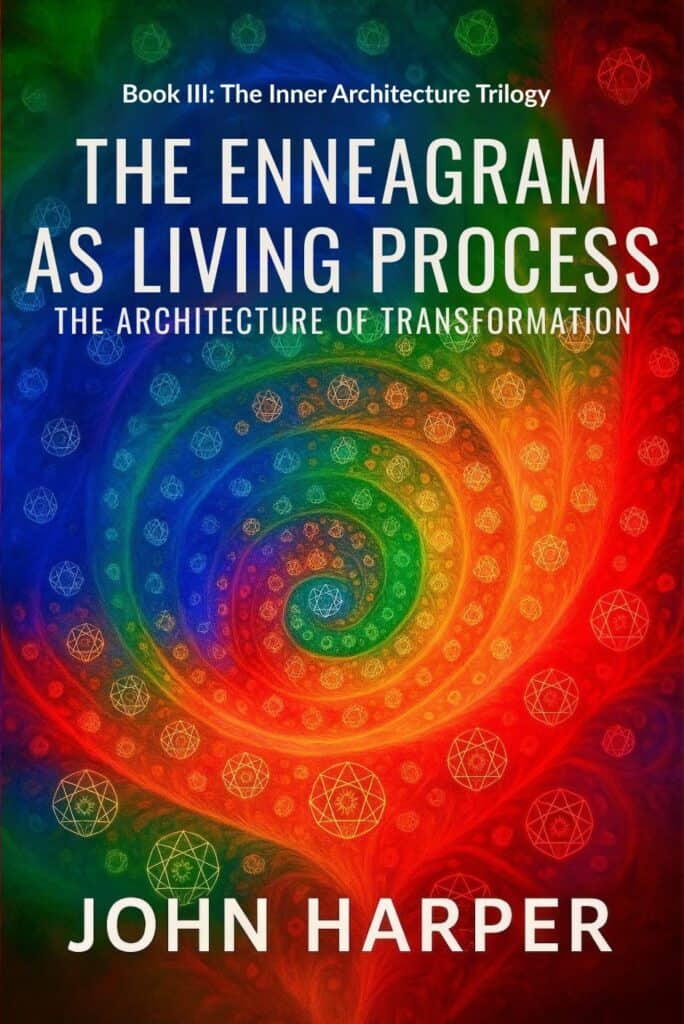
The Enneagram was never meant to be a behavioral corrective system. It was never intended as a toolkit that the ego uses to improve itself. When Gurdjieff, Ichazo, Naranjo, and the early lineage-bearers spoke about the Work, they never suggested that the personality could pull itself up by its bootstraps. They pointed to the infiltration of essence into personality. They pointed to real presence rather than self-improvement. They pointed to the operator’s dissolution, not its upgrading. (We address this in detail in our book The Enneagram as Living Process.)
So much of Enneagram culture still says: do better, know better, be better, shift your type. But the deeper invitation is different. It is not asking the EnneaType to become something new. It is inviting awareness to touch the type as it is. When that happens, transformation unfolds on its own. Fixation loosens, defenses soften, the lost essential qualities reappear, and the type reorganizes around truth instead of habit.
There is no little self at the center of each type pulling levers and making choices. There is only a mental process of a conditioned personality. And beneath it, there is deeper presence available.
From Self-Improvement to Self-Revelation
The Enneagram’s homunculus problem disappears the moment we stop asking the type to fix itself and instead turn toward the movement of Being that is us.
John Harper is a Diamond Approach® teacher, Enneagram guide, and lifelong student of human development whose work bridges psychology, spirituality, and deep experiential inquiry. His flagship project, The Inner Architecture Trilogy—Why Study Personality?, The Alchemy of Perception, The Enneagram as Living Process, explores the fundamental structures of consciousness from three interconnected dimensions: perception, process, and vibration.
He is also the author of Nurturing Essence: A Compass for Essential Parenting, The Enneagram World of the Child: Nurturing Resilience and Self-Compassion in Early Life, works that illuminate how essence shapes early psychological development. All titles are available on Amazon.
As a former student of Naranjo, I appreciate this way of understanding the enneagram.
Thanks Susan