

An Inquiry into the Enneagram of Universal Process
(See Author’s Note at Bottom of Page)
In my book The Enneagram & the Arc of Transformation, I explored the possibility that the Diamond Approach and Gurdjieff’s understanding of the Enneagram might be describing aspects of the same transformational territory. The goal was not to prove that one system emerged from the other, nor to suggest that they are identical. Rather, it was an exercise in curiosity. What happens when two seemingly different maps are placed side by side? Do they illuminate one another, or do they reveal entirely different landscapes?
That exploration left me with another question: What happens if we perform the same exercise with Buddhism?
At first glance, the comparison seems unlikely. Buddhism emerged more than two thousand years before Gurdjieff introduced the Enneagram to the modern world. Its language, methods, assumptions, and cultural foundations differ dramatically from those of the Fourth Way. The Buddha did not teach the Enneagram, and Gurdjieff did not teach Buddhism. Any attempt to force one system into the framework of the other would inevitably distort both.
Yet there is another possibility worth considering: What if both traditions were attempting to understand the same fundamental problem? What if they were observing the same territory of human experience from different vantage points and using different language to describe what they found? More importantly, what if the similarities and differences between them could help illuminate something that neither system fully reveals on its own?
The purpose of this article is not to argue that Buddhism fits neatly inside the Enneagram. Instead, I would like to approach the question as an inquiry. If we begin with the Buddha’s central discoveries and then examine Gurdjieff’s Enneagram of Universal Process, do any meaningful correspondences emerge? Are there recognizable developmental thresholds, recurring challenges, or similar transformational movements that appear within both systems?
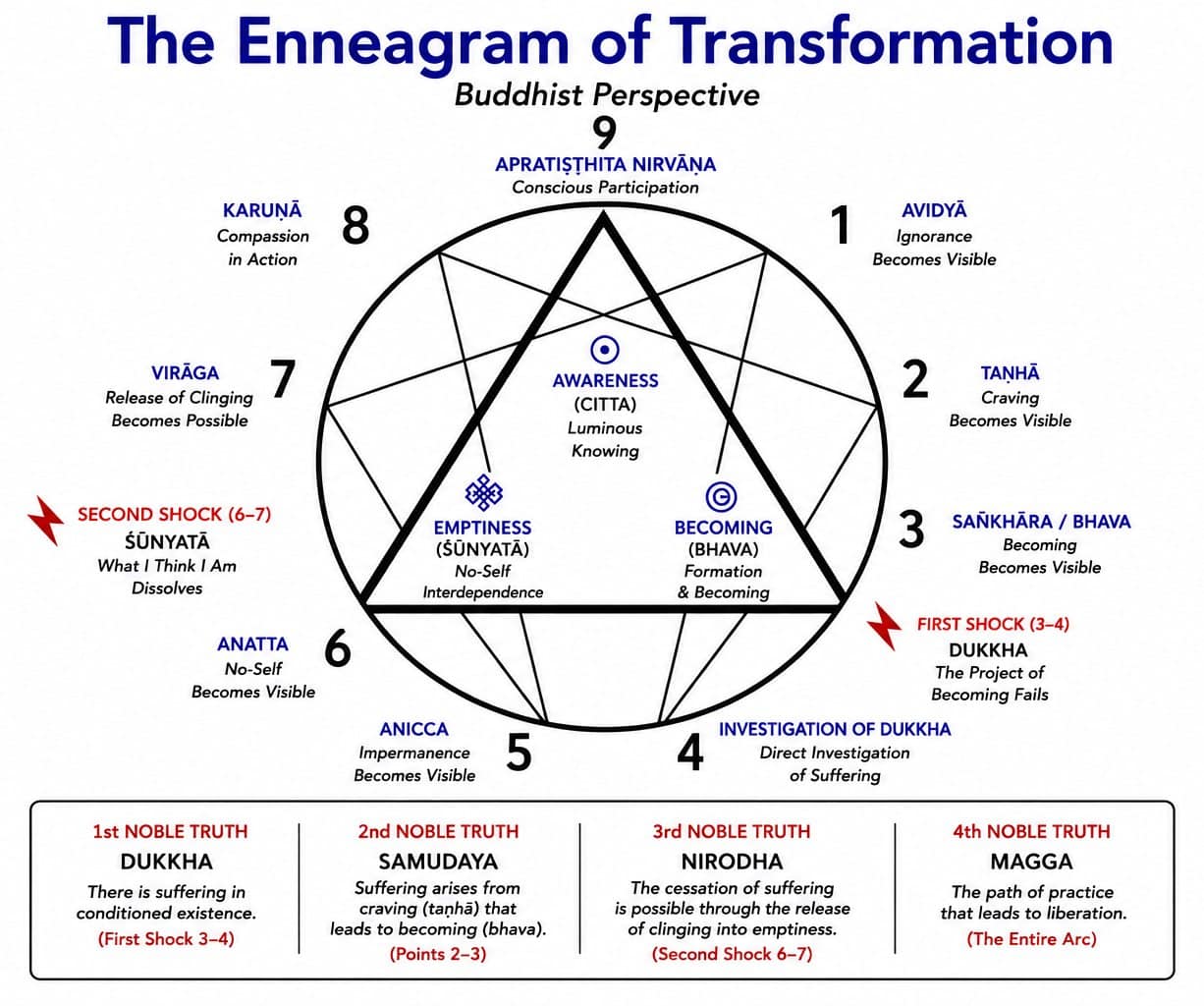
To answer this question, it makes sense to begin where the Buddha began.
This is perhaps the first surprise.
The Buddha did not begin with enlightenment. He did not begin with mystical experience, transcendence, cosmic consciousness, or metaphysical speculation. He began with suffering. In fact, one could argue that the entirety of Buddhism grows out of a single observation: there is something fundamentally unsatisfactory about ordinary human existence, and understanding that dissatisfaction is essential if genuine freedom is to be discovered.
Why suffering?
- Why would one of humanity’s most influential spiritual traditions place suffering at the center of its teaching?
- Why would a prince, surrounded by privilege, comfort, and opportunity, abandon everything in pursuit of an answer to that question?
- Why would the First Noble Truth focus not on liberation but on dukkha?
The more I contemplated these questions, the more another possibility began presenting itself.
Perhaps the transformational journey does not begin with awakening at all. Perhaps it begins when the structures that organize ordinary life begin revealing their limitations. Perhaps transformation starts when the assumptions we have relied upon for security, meaning, and fulfillment cease to provide what they promise. If that is true, then the Buddha’s emphasis on suffering may not be pessimistic. It may be diagnostic. It may represent the first recognition that the machinery through which we ordinarily navigate life cannot ultimately deliver the freedom we seek.
This possibility also raises questions about Gurdjieff’s Enneagram.
When most people encounter the Enneagram today, they encounter a system of personality types. Gurdjieff’s use of the symbol was very different. He presented it as a universal process model, a description of lawful movements that appear throughout nature, development, transformation, and creation itself. If the Enneagram is approached from that perspective, a question emerges: Does the Buddha’s investigation of suffering reveal movements that correspond to the transformational arc described within the symbol?
I do not know the answer. That uncertainty is precisely what makes the inquiry interesting.
Rather than beginning with conclusions, let us begin with the Buddha’s first observation and see where it leads. If meaningful correspondences emerge, they should reveal themselves naturally. If they do not, that discovery may be equally valuable. Either way, the journey begins in the same place that Buddhism begins: not with enlightenment, but with the mystery of suffering itself.
Before Dukkha: Ignorance, Craving, and Becoming
Before arriving at suffering, the Buddha appears to have recognized something even more fundamental: Human beings do not simply suffer; they organize their lives in ways that inevitably generate suffering. The question, therefore, becomes: What are the forces that shape this organization?
Buddhism begins with avidyā, usually translated as ignorance. This does not refer to a lack of intelligence or information. Rather, it points toward a misperception of reality. We mistake the impermanent for the permanent, the conditioned for the unconditioned, and the constructed for the real. Through this misunderstanding, consciousness begins dividing experience into categories of desirable and undesirable, pleasant and unpleasant, wanted and unwanted.
From this division emerges taṇhā, often translated as craving. Experience becomes organized around attraction and avoidance. We move toward what appears capable of completing us and away from what appears threatening or uncomfortable. Much of ordinary life unfolds within this dynamic, often without our recognizing how thoroughly it shapes our perceptions, choices, and relationships.
The Buddha’s inquiry did not stop there; he also observed the continual tendency of the mind to construct and reconstruct experience through what Buddhism calls saṅkhāra, the formations and conditioning activities that continually shape perception, identity, and behavior. Through these formations, consciousness becomes organized around bhava, the process of becoming. We are no longer simply living; we are becoming someone, becoming something, becoming more secure, more successful, more spiritual, more complete.
At this point, I find myself wondering whether these observations bear any resemblance to the upper arc of Gurdjieff’s Enneagram. If Point One reflects the structuring of perception, Point Two the emergence of attachment, and Point Three the project of becoming, then the territory described by Buddhism begins looking surprisingly familiar. Whether this similarity is meaningful or merely coincidental remains an open question, but it prepares the ground for the Buddha’s first major discovery: dukkha.
The Discovery of Dukkha
One of the challenges modern readers face when approaching Buddhism is that many of its central concepts have become overly familiar. Words such as enlightenment, mindfulness, karma, meditation, and suffering have entered popular culture to such an extent that they have lost their original significance. We assume we know what they mean because we recognize the words, yet familiarity can sometimes obscure understanding rather than deepen it.
The Buddhist concept of dukkha may be one of the clearest examples.
Dukkha is commonly translated as suffering, but that translation captures only part of its meaning. Certainly, physical pain, grief, loss, illness, disappointment, and emotional distress are included within its scope. Yet the Buddha appears to have been pointing toward something more pervasive than episodic suffering. He was drawing attention to a fundamental characteristic of conditioned existence, a subtle but persistent dissatisfaction that accompanies even the most pleasant experiences.
This observation initially sounds strange. After all, much of human life is devoted to the pursuit of happiness. We seek meaningful work, intimate relationships, financial security, creative expression, knowledge, accomplishment, and spiritual fulfillment. These pursuits often bring genuine joy and satisfaction. The Buddha was not denying this. Rather, he was asking a deeper question: Why do even our most cherished experiences fail to provide the lasting fulfillment we hope for?
The question becomes increasingly difficult to avoid as we move through life.
A long-sought achievement finally arrives, bringing excitement and satisfaction, yet after a period of time, the experience begins fading into memory. A relationship blossoms and fills life with meaning, yet both people continue to change and evolve, creating new challenges and uncertainties. A profound insight appears during meditation or contemplation, illuminating reality in a fresh way, yet eventually the experience recedes, and ordinary life resumes. Again and again, we encounter moments of beauty, meaning, and fulfillment, yet none of them seem capable of providing permanent refuge from change.
The Buddha’s genius may have been his willingness to investigate this observation rather than dismiss it. Instead of assuming that fulfillment remained somewhere beyond the next accomplishment, relationship, or realization, he examined the structure of experience. His inquiry appears to have revealed that suffering is not merely something that happens to us; it arises from the way consciousness relates to reality, particularly from the tendency to seek permanence in what is inherently impermanent.
This is where the inquiry begins intersecting with Gurdjieff’s Enneagram.
Within the Enneagram of Universal Process, the first shock occurs between Points Three and Four. In The Enneagram & the Arc of Transformation, I describe this as the place where the project of becoming encounters its limitations. The individual has invested tremendous energy into constructing an identity, pursuing goals, acquiring knowledge, achieving success, or becoming a particular kind of person. Yet eventually, something begins to crack; the strategies that once seemed capable of delivering fulfillment begin to reveal their limitations.
The similarity to the Buddha’s observation is difficult to ignore. Both appear to identify a moment when ordinary assumptions about life begin losing their credibility. The individual discovers that the problem is not a lack of effort, a lack of achievement, or a lack of understanding; the problem lies deeper. It rests on the assumption that lasting fulfillment can be secured through constantly changing conditions.
At this point, however, an important distinction must be made; the Buddha was not interested in creating a philosophy of suffering. He was not proposing pessimism, nihilism, or resignation. The First Noble Truth does not end the inquiry. It begins it. In many ways, it functions like a physician’s diagnosis: before healing can occur, the condition must first be accurately recognized.
This raises a question that becomes increasingly important as we continue our exploration: If suffering is not merely the result of unfortunate circumstances, and if it emerges from something more fundamental in how consciousness relates to experience, what exactly is the mechanism by which suffering is created?
The Buddha’s answer leads directly into his next major discovery, one that may reveal even more correspondence with the Enneagram. To understand suffering, he argued, we must understand attachment. To understand attachment, we must understand why the mind continually grasps at experiences, identities, relationships, and states of being as though they could provide permanence in a world defined by change.
This investigation ultimately leads to one of Buddhism’s most profound observations: The recognition that everything we cling to is impermanent. And it is here, perhaps, that the inquiry begins moving toward territory that resembles Point Five on the Enneagram.
Impermanence and the Mystery of Change
If suffering occupies the center of the Buddha’s inquiry, impermanence occupies the center of his explanation.
This immediately raises questions:
- Why does Buddhism place such extraordinary emphasis on change?
- Why do Buddhist practitioners spend countless hours observing thoughts arise and pass away, emotions emerge and dissolve, sensations appear and disappear, and experiences continuously transform from one moment to the next?
- Why is the observation of impermanence considered so important that it appears throughout virtually every school of Buddhist practice?
For many people, impermanence seems obvious; everything changes, bodies age, relationships evolve, careers begin and end, civilizations rise and fall, and eventually every living thing dies. None of this appears particularly mysterious. Yet the Buddha seems to have discovered something within this observation that goes far beyond the simple recognition that life changes.
The issue is not merely that things change; the issue is that human beings continually relate to changing things as though they should not change:
- We fall in love and secretly hope the relationship will remain exactly as it is.
- We achieve a goal and wish the satisfaction it brings would last indefinitely.
- We experience a moment of peace and immediately begin wondering how to preserve it.
- We encounter success and attempt to extend it. We encounter pleasure and attempt to repeat it.
Even when we understand intellectually that everything changes, another part of us continues to behave as though permanence were somehow possible. This tension appears to lie at the heart of what the Buddha was investigating.
The problem is not change. Seasons change, weather changes, ecosystems change, and life unfolds through continuous transformation. The problem emerges when consciousness demands stability from what is inherently unstable. The more tightly we grasp at what is changing, the more suffering tends to arise. The more we insist that reality conform to our preferences, the more friction develops between our expectations and the way things actually are.
What makes this insight particularly fascinating is that it is not primarily philosophical. Buddhism does not ask practitioners to believe in impermanence; it asks them to observe it.
A person sits quietly and watches the breath. Sensations emerge and disappear. Thoughts arrive unexpectedly and depart just as quickly. Emotional states that once seemed overwhelming reveal themselves to be temporary. Memories drift into awareness and then fade. Even the sense of being a stable, continuous self begins to display a surprising degree of movement and fluidity. Over time, the practitioner begins to see impermanence not as an idea but as a direct characteristic of experience.
If the first shock corresponds to the recognition of dukkha, then what follows? According to Gurdjieff’s symbol, the movement continues into territory associated with deeper observation and greater awareness of process. The individual begins seeing what was previously hidden by identification. Rather than remaining completely absorbed in experience, they develop the capacity to observe experience.
The correspondence is not exact, nor should we expect it to be. Nevertheless, one cannot help noticing that Buddhism’s emphasis on impermanence serves a similar function. The practitioner is no longer focused exclusively on the contents of experience. Attention begins shifting toward the nature of experience itself. Instead of asking whether a thought is true or false, pleasant or unpleasant, attention turns toward the fact that the thought arose and passed away. Instead of becoming completely absorbed in an emotion, the practitioner begins noticing its movement, duration, intensity, and eventual dissolution.
Something subtle but profound begins to happen through this process; the authority of experience starts to change. Thoughts still occur, but they no longer appear quite as solid. Emotions still arise, but they no longer seem quite as permanent. Reactions continue appearing, yet they become increasingly visible as movements within consciousness rather than unquestionable facts about reality. The practitioner discovers that much of what once felt fixed is actually in motion.
This observation eventually leads to deeper questions:
- If everything that can be observed is changing, what exactly is it that remains constant?
- If thoughts change, emotions change, sensations change, beliefs change, memories change, relationships change, and circumstances change, where exactly is the stable center around which all of this change is occurring?
If there is a correspondence here with Gurdjieff’s Enneagram, it may lie in the movement often associated with Point Five. The practitioner is no longer focused exclusively on the contents of experience but is beginning to observe the process through which experience unfolds. Whether Buddhism and the Enneagram are describing the same territory remains uncertain, yet both seem to place extraordinary importance on the capacity to observe rather than merely react.
The Buddha’s investigation of impermanence appears to have led directly to that question. Rather than concluding with the observation that everything changes, he continued looking. As he did, the inquiry moved into territory that many people find both fascinating and unsettling.
The question was no longer simply why things change; it became whether the self that appears to experience those changes possesses the permanence we usually assume it has. It is here that the inquiry begins approaching one of Buddhism’s most radical and transformative discoveries.
No-Self and the Question of Who Is Suffering
For many people encountering Buddhism for the first time, no teaching appears more perplexing than the doctrine of anatta, usually translated as “no-self.” At first glance, the idea seems absurd. We experience ourselves as individuals. We have names, histories, memories, preferences, relationships, responsibilities, and personal identities. We make decisions, pursue goals, and navigate our lives through what appears to be a continuous sense of self. Why would the Buddha claim that such a self does not exist?
Part of the confusion arises because Western readers often interpret the teaching as a philosophical declaration. It sounds as though Buddhism is making a metaphysical claim about reality, asserting that people do not exist or that individuality is somehow an illusion. Yet when one examines the Buddha’s method more carefully, a different picture begins emerging. Rather than asking people to believe in no-self, he appears to be inviting them to investigate the nature of self directly.
The distinction is important. The Buddha does not begin by telling us what to think; he begins by encouraging us to look:
- What actually constitutes the self?
- Where is it located?
- What is it made of?
- Can it be found directly within experience?
These questions become particularly relevant once impermanence has been observed carefully:
- If thoughts continuously change, can thoughts be the self?
- If emotions continuously change, can emotions be the self?
- If bodily sensations continuously change, can sensations be the self?
- If beliefs, memories, opinions, roles, and identities all change over time, which of these constitutes the stable and enduring center we call “I”?
The Buddha’s investigation appears to have led him toward a startling conclusion: What we call the self is not a single thing but a collection of processes. In Buddhist language, these processes are often described through the Five Aggregates: form, sensation, perception, mental formations, and consciousness. Together, they create the experience of being a person, and together they create continuity, identity, and individuality. Yet none of them, individually or collectively, appears to possess the permanence and independence we usually attribute to a self.
This is where the inquiry becomes genuinely unsettling. Most people assume that suffering happens to someone, that pain belongs to someone, that fear belongs to someone, and that anxiety belongs to someone.
The question gradually shifts:
Instead of asking, “Why am I suffering?” one begins asking, “Who is suffering?”
Instead of asking, “How can I become free?” one begins asking, “Who is attempting to become free?”
At first, these questions may sound merely philosophical. Yet within Buddhist practice, they function as experiential investigations. The practitioner is encouraged to examine experience directly and determine whether a permanent, independent self can actually be located. The answer is not meant to be accepted on authority; it is meant to be discovered through observation.
This is where the inquiry begins moving beyond impermanence and toward something even more profound; it’s one thing to recognize that everything changes.; it’s another thing entirely to recognize that what appears to be a separate self may itself be part of that changing process.
The implications are enormous.
If the self is not what we assume it to be, then many of the structures that generate suffering begin appearing in a new light:
- Attachment becomes more understandable because it is no longer merely the self grasping at objects; it becomes part of a larger process through which identity attempts to establish continuity.
- Fear becomes more understandable because it is no longer merely an emotional reaction; it becomes part of a system attempting to preserve something that may not exist as it imagines it.
One of the reasons I find this stage of the inquiry so fascinating is that it appears to occupy territory that resembles Point Six on Gurdjieff’s Enneagram. Point Six has often been associated with certainty, doubt, trust, authority, and the search for solid ground. The practitioner reaches a place where many of the assumptions that previously organized life have begun dissolving, yet no new certainty has appeared to replace them.
This creates a dilemma.
The mind naturally wants conclusions; it wants a stable position from which to understand reality. Yet the Buddha’s investigation seems to move in the opposite direction. Rather than providing a new certainty, it systematically examines the certainties we already possess and asks whether they can withstand careful observation.
Perhaps this is why so many Buddhist texts describe awakening not as the acquisition of knowledge but as the relinquishment of ignorance. The process is not necessarily about finding something new; it’s about seeing through assumptions that were never examined closely in the first place.
Yet the Buddha’s inquiry did not end with no-self; in many ways, it was only beginning.
As the investigation deepened, attention moved beyond the question of self and toward an even more fundamental observation: Things not only lack permanence; they also appear to lack independent existence. Every phenomenon seems to arise through causes, conditions, relationships, and interconnections. Nothing stands entirely on its own.
This realization would eventually become one of the central insights of Mahayana Buddhism, expressed through the profound and often misunderstood teaching of emptiness.
Emptiness and Dependent Origination
If the teaching of no-self challenges our assumptions about who we are, the teaching of emptiness challenges our assumptions about what reality is.
Few Buddhist concepts have generated more confusion than sunyata, usually translated as emptiness. To many Western readers, the word immediately suggests absence, negation, or some form of cosmic nothingness. It sounds as though Buddhism is claiming that nothing exists or that reality is somehow unreal. Yet the deeper one investigates the Buddhist understanding of emptiness, the more apparent it becomes that this interpretation misses the point entirely.
Emptiness is not the claim that things do not exist; it’s the observation that things do not exist independently.
This distinction changes everything.
To understand what the Buddha and later Mahayana teachers were attempting to illuminate, it’s helpful to begin with ordinary experience. Consider a tree. We naturally speak of the tree as though it were a separate object existing on its own. Yet upon closer examination, the tree reveals itself to be inseparable from countless conditions. It depends upon soil, water, sunlight, atmosphere, microorganisms, seasons, gravity, and an almost unimaginable network of ecological relationships. Remove those conditions, and the tree cannot exist.
The same observation applies everywhere:
- A wave exists, yet it cannot be separated from the ocean that gives rise to it.
- A conversation exists, yet it cannot be separated from the people participating in it.
- A human being exists, yet that existence depends upon parents, language, culture, history, biology, food, relationships, and countless experiences accumulated throughout a lifetime.
The deeper one looks, the more impossible it becomes to find anything that stands completely alone.
This insight is closely related to one of Buddhism’s most profound teachings: dependent origination, or pratityasamutpada. The doctrine is often summarized through a simple observation: this arises because that arises; this ceases because that ceases. Every phenomenon appears within a web of causes and conditions. Nothing emerges independently, and nothing remains entirely separate from the larger processes through which it comes into being.
At first glance, this may appear to be little more than a philosophical idea. Yet within Buddhism, it occupies a central place because it fundamentally changes how suffering is understood. If things arise through conditions, then suffering also arises through conditions. If suffering arises through conditions, then it is neither random nor inevitable. It can be investigated. Its causes can be understood. The conditions that sustain it can be examined. Liberation becomes possible because suffering is no longer viewed as an immutable fact but as part of a larger process.
This is one of the reasons dependent origination sits at the heart of Buddhist thought; it provides the bridge between the First Noble Truth and the possibility of awakening. The Buddha was not merely interested in observing suffering; he wanted to understand how it comes into existence. By tracing the chain of causes and conditions, he discovered that suffering arises through identifiable processes rather than through fate, divine punishment, or inherent human deficiency.
The next paragraph already explains exactly how it undermines separateness.
As long as reality is perceived as a collection of independent things, the self naturally appears to be one more independent thing among many. Yet when existence is viewed through the lens of dependent origination, the boundaries begin looking less solid than they first appeared. Every phenomenon participates in a larger field of relationships, and every event depends upon countless conditions extending far beyond itself. The distinction between separate and interconnected begins to reveal itself as far more fluid than ordinary perception assumes.
This movement bears an intriguing resemblance to the territory surrounding Point Six and the second shock in Gurdjieff’s Enneagram. Earlier in the process, the individual seeks certainty through identity, belief, accomplishment, knowledge, and understanding. Gradually, those structures begin loosening. The practitioner discovers that many of the things they assumed were fixed are actually fluid, and many of the things they assumed were separate are deeply interconnected.
Such discoveries can be both liberating and disorienting.
When familiar assumptions begin dissolving, the mind often attempts to restore certainty as quickly as possible. New beliefs replace old beliefs. New identities replace old identities. New explanations replace old explanations. Yet Buddhism repeatedly points in a different direction. Rather than rushing to establish a new conceptual foundation, practitioners are encouraged to remain present with the uncertainty; to continue observing.
This may be one of the most difficult aspects of the journey. Human beings generally prefer conclusions to questions, certainty to ambiguity, and arrival to remaining in the middle of an investigation. Yet the territory explored through emptiness often refuses premature conclusions. The more carefully one examines reality, the more mysterious it becomes. Things continue to exist, yet they do not appear to exist as we originally assumed. The self continues functioning, yet it no longer appears entirely separate from the larger field of conditions that gives rise to it.
Perhaps this is why emptiness is so often described as liberating. It loosens the rigid structures through which reality is normally interpreted. The world becomes less fixed, less solid, and less constrained by the categories through which the mind habitually organizes experience. What initially appeared threatening begins revealing an unexpected spaciousness.
If the second shock in Gurdjieff’s Enneagram represents the loosening of attachment to certainty, the realization of emptiness appears to occupy strikingly similar territory. The practitioner is no longer seeking a new conceptual foundation upon which to stand. Instead, they are learning to remain present within a reality that is more fluid, interconnected, and mysterious than previously imagined.
What makes this intriguing is that the two shocks appear to address different layers of identification. The first shock emerges when the psychological project of becoming begins revealing its limitations. The identities, ambitions, self-images, and strategies through which the individual has organized their life no longer provide the fulfillment they once promised. The second shock penetrates more deeply. Here, the inquiry is no longer concerned primarily with who I think I am but with what I think I am. The assumption of a separate, independent entity standing apart from reality becomes the object of investigation. Viewed through this lens, the transformational arc described by the Enneagram and the movement from dukkha through emptiness in Buddhism appear less like isolated insights and more like a progressive dismantling of identification.
Yet Buddhism does not stop there.
One of the most remarkable aspects of the tradition is that the realization of emptiness does not culminate in withdrawal from life. It does not produce indifference, passivity, or disengagement. Quite the opposite: the deeper the realization of interconnectedness becomes, the more naturally compassion emerges.
This raises more questions:
- Why should the realization of emptiness lead to compassion?
- Why would seeing through the illusion of separateness result not in detachment from the world but in a deeper participation within it?
The answer to that question lies at the heart of the Bodhisattva ideal and may reveal one of the strongest correspondences between Buddhism and the final stages of Gurdjieff’s transformational arc.
The Bodhisattva and the Return to the World
One of the most surprising developments in Buddhism occurs precisely where many people expect the journey to end. If suffering arises through attachment, and attachment arises through ignorance, then it would seem reasonable to assume that liberation culminates in a kind of withdrawal from ordinary life. Having seen through illusion, recognized impermanence, investigated no-self, and realized emptiness, one might expect the awakened individual to retreat from the world altogether.
Yet this is not what happened.
As Buddhism evolved, particularly within the Mahayana tradition, a different vision emerged. Rather than portraying awakening as an escape from the world, Mahayana Buddhism increasingly emphasized the figure of the Bodhisattva, the individual who realizes the nature of reality yet remains actively engaged in the world of human suffering.
This development deserves careful attention because it raises a profound question:
- Why would deeper realization lead to greater participation rather than less participation?
- Why would seeing through the illusion of separateness result not in detachment from others but in a deeper sense of connection with them?
The answer appears to lie within the very insights we have been exploring.
If the self is not as separate as it first appears, and if reality is fundamentally characterized by interdependence rather than isolation, then the suffering of others can no longer be viewed as entirely unrelated to one’s experience. The rigid boundary between self and other begins softening. What was previously experienced as “their suffering” begins revealing itself as part of a larger field of shared human experience.
This does not mean individuality disappears. The Bodhisattva does not become an undifferentiated abstraction floating above ordinary life. Individuals continue to exist, relationships continue to exist, and unique circumstances continue to exist. What changes is the perception of separation. The practitioner increasingly recognizes that all beings participate within the same web of causes and conditions, face the same realities of impermanence and loss, and struggle with many of the same forms of attachment and confusion.
Compassion naturally emerges from this recognition.
Importantly, Buddhism does not generally present compassion as a moral commandment imposed from outside. Compassion is not simply something one ought to do in order to be virtuous. Rather, it appears as a natural consequence of understanding. The clearer one sees the nature of suffering within oneself, the easier it becomes to recognize that suffering in others. The clearer one sees the mechanisms of attachment, fear, craving, and confusion at work within one’s experience, the easier it becomes to recognize those same mechanisms at work throughout humanity.
In this sense, compassion represents not the opposite of wisdom but one of its expressions.
The Bodhisattva ideal, therefore, suggests that awakening is incomplete if it remains purely personal. Insight must eventually find expression in relationship. Understanding must eventually find expression in action. Realization must eventually find expression in the ordinary circumstances of life. The journey does not end with what one sees; it continues through how one lives.
This is where the inquiry begins, revealing what may be one of its most intriguing correspondences with Gurdjieff’s Enneagram.
If the movement through the lower arc involves the gradual dissolution of identification, one might reasonably expect the process to culminate in detachment or withdrawal. Yet Gurdjieff’s symbol appears to suggest something different. As the arc approaches completion, the movement does not disappear from life. It returns to life. The individual does not leave the world behind. Rather, they begin participating in it from a fundamentally different orientation.
The similarity is striking. Both systems describe a movement in which freedom from identification does not lead away from relationship but toward a deeper capacity for relationship. Both suggest that genuine realization is measured less by escape from ordinary existence than by conscious participation within it. Both imply that the fruits of transformation become visible not merely through insight but through embodiment.
Of course, similarities should not be mistaken for equivalence. The Bodhisattva ideal emerged within a specifically Buddhist framework and carries meanings that cannot be reduced to any other system. Yet it is difficult to ignore the possibility that both traditions are pointing toward a common observation: the deeper one’s realization becomes, the more naturally life becomes the arena through which that realization expresses itself.
The movement described by the Bodhisattva ideal bears a particularly intriguing resemblance to Point Eight within the Enneagram. Freedom from identification does not culminate in withdrawal. It becomes embodied as participation, service, responsiveness, and compassionate engagement with life. Whether the correspondence is exact is less important than the observation that both traditions suggest that realization ultimately expresses itself through embodied relationship rather than isolation.
The Mahayana answer to this question leads into the subtle and often misunderstood teaching of apratiṣṭhita-nirvāṇa, non-abiding nirvana, a teaching that may illuminate the final movement of both the Buddhist path and the Enneagram’s transformational arc.
Non-Abiding Nirvana and Conscious Participation
When most people hear the word nirvana, they imagine a final destination. The image often resembles a spiritual finish line, a transcendent state beyond suffering, beyond struggle, and perhaps beyond ordinary human existence altogether. Popular interpretations frequently portray enlightenment as an escape from the world, a departure from life’s complexities into a state of permanent peace.
Yet the deeper one explores Mahayana Buddhism, the more complicated the picture becomes. If awakening culminated in withdrawal from existence, the Bodhisattva ideal would make little sense.
- Why would someone who had realized the nature of reality remain engaged in a world characterized by impermanence, uncertainty, and suffering?
- Why return to relationship, responsibility, and participation if liberation consisted of leaving such things behind?
The Mahayana response is both subtle and profound. It suggests that the apparent opposition between samsara and nirvana may itself be part of the misunderstanding.
Samsara is often described as the world of suffering, while nirvana is described as liberation. At first glance, they appear to be opposites. One is the problem; the other is the solution. One is bondage; the other is freedom. Yet many Mahayana teachers argue that the distinction is not quite so simple. The world itself is not the problem, impermanence is not the problem, relationship is not the problem, and life is not the problem.
The problem lies in how reality is perceived and how consciousness relates to that perception.
From this perspective, awakening does not require abandoning the world; it requires seeing the world differently. The same reality remains, yet the structures of grasping, resistance, and identification through which that reality was previously interpreted are beginning to lose their dominance. What changes is not existence but the relationship to existence.
This insight eventually gave rise to the Mahayana teaching of apratiṣṭhita nirvāṇa, often translated as non-abiding nirvana. The term points toward a form of liberation that does not take up residence anywhere. The practitioner does not abide in samsara, trapped by attachment and ignorance. Nor do they abide in nirvana as a separate state removed from ordinary existence. Instead, they participate freely in reality without becoming fixed in either position.
This teaching is particularly fascinating because it avoids two extremes that have appeared repeatedly throughout human spiritual history. On one side lies complete immersion in worldly life, where identity becomes entirely absorbed in achievement, relationship, status, security, and personal concerns. On the other side lies the temptation toward withdrawal, where spirituality becomes an escape from the difficulties and ambiguities of existence. Non-abiding nirvana points beyond both possibilities.
Seen through the lens of the Enneagram, one might describe this as the completion of the transformational arc. The circle has not been escaped. The process has not been transcended. Rather, participation within the process has become conscious. This possibility is one of the reasons I find the comparison between Buddhism and Gurdjieff so compelling.
The awakened individual neither clings to the world nor rejects it; they participate.
This is where the inquiry begins revealing what may be one of the most compelling correspondences with Gurdjieff’s Enneagram of Universal Process.
As the transformational arc approaches completion, the movement does not terminate. The process continues. Life continues unfolding. Challenges continue to arise. Relationships continue evolving. The body continues aging. The world remains characterized by uncertainty and change. Yet the quality of participation has fundamentally shifted because the individual is no longer relating to life from the same level of identification.
What originally attracted me to Gurdjieff’s understanding of the Enneagram was precisely this emphasis on participation. The symbol does not appear to describe escape from process; it describes increasingly conscious participation within process. At the beginning of the journey, the individual participates mechanically. Habit, conditioning, fear, desire, and attachment largely determine the quality of engagement. As transformation unfolds, participation becomes progressively more conscious. Awareness begins recognizing the process while simultaneously participating in it.
The similarity to non-abiding nirvana is difficult to overlook.
Neither vision culminates in disengagement, neither proposes that realization requires abandoning ordinary life. Instead, both seem to point toward a mode of existence in which consciousness can participate fully without becoming imprisoned by the structures through which it once interpreted reality.
Perhaps this is why mature spiritual realization so often appears ordinary from the outside. The individual continues working, relating, creating, teaching, parenting, serving, and participating in the countless activities that constitute human life. What has changed is not necessarily the activity itself but the relationship to that activity. Less energy is devoted to defending identity. Less energy is devoted to preserving psychological positions. Less energy is devoted to demanding that reality conform to personal expectations.
Life continues, participation continues, yet the quality of participation has been transformed.
This observation brings us back to the central question that initiated this inquiry: Are Buddhism and Gurdjieff’s Enneagram describing the same thing? The answer is almost certainly no if by “the same thing” we mean identical teachings, identical methods, or identical philosophies. The differences between them are significant and cannot be ignored. Yet another possibility remains worth considering:
- What if both traditions discovered recurring features of the transformational journey?
- What if they identified similar thresholds, similar obstacles, similar dissolutions, and similar forms of realization, even though they articulated those discoveries through different languages and symbols?
- What if the correspondences we have observed throughout this inquiry are not accidental but reflect something lawful about the way consciousness awakens to itself?
These questions do not lend themselves to easy answers; they invite further investigation. And it is precisely that investigation that brings us back to the Enneagram and the broader implications of what Gurdjieff may have been attempting to communicate through the symbol.
What Does This Reveal About the Enneagram?
At the beginning of this inquiry, I posed a relatively simple question: If we start with the Buddha’s major discoveries and then examine Gurdjieff’s Enneagram of Universal Process, do any meaningful correspondences emerge?
Having traveled through the inquiry, I find myself both surprised and cautious.
Surprised because the parallels are often difficult to ignore. The Buddha begins with suffering. The transformational arc appears to begin when the ordinary machinery of life reveals its inability to provide lasting fulfillment. The Buddha turns toward impermanence as a central insight. The transformational process likewise appears to require a growing recognition of change, fluidity, and the instability of the structures upon which identity depends. The Buddha investigates the nature of self and discovers something far less solid than conventional assumptions suggest. The Enneagram’s movement through the lower arc appears to involve a similar loosening of identification and certainty. The realization of interconnectedness gives rise to compassion, and the culmination of the path returns the practitioner to conscious participation rather than withdrawal.
These observations are intriguing, yet caution is equally important.
It would be easy to force the comparison too far. Buddhism is not the Enneagram. Gurdjieff’s teachings are not Buddhism. The Buddha’s discoveries emerged within a cultural, philosophical, and contemplative context vastly different from the one in which Gurdjieff taught. Each tradition possesses its own language, assumptions, methods, and aims. Any attempt to erase those differences would ultimately diminish both.
What interests me is something else. The question is not whether the systems are identical. The question is whether they may be observing recurring features of human transformation.
After all, if suffering is a universal human experience, one might expect contemplative traditions to encounter it. If attachment contributes to suffering, one might expect traditions to investigate attachment. If impermanence is woven into the fabric of existence, one might expect serious practitioners to notice it. If identity is less stable than it appears, one might expect multiple traditions to explore that territory. If compassion naturally emerges from a deeper understanding of reality, one might expect that discovery to appear repeatedly throughout the history of spiritual inquiry.
Viewed from this perspective, the correspondences become less surprising.
Different explorers may use different maps. They may speak different languages. They may approach the mountain from different directions. Yet if they are exploring the same terrain, one would expect certain landmarks to recur.
This possibility is what continues to fascinate me about Gurdjieff’s original understanding of the Enneagram.
Modern presentations often reduce the symbol to personality. While personality applications can certainly be valuable, Gurdjieff appears to have intended something far larger. He described the Enneagram as a symbol of lawful process, a representation of recurring patterns that appear throughout nature, development, transformation, and creation itself. If that is true, then we should not be surprised to find echoes of the same pattern appearing in unexpected places.
The real question becomes whether those echoes reveal something fundamental about the nature of transformation.
Perhaps the most interesting observation to emerge from this inquiry is that neither Buddhism nor the Enneagram appears primarily concerned with self-improvement. Both point toward something deeper than becoming a better version of oneself. The Buddha’s inquiry repeatedly undermines the assumptions upon which the ordinary sense of self is built. Likewise, the transformational arc described by the Enneagram appears to involve the gradual recognition and loosening of the structures through which identity organizes experience.
In both cases, the journey seems less concerned with adding something new than with seeing something that was previously hidden.
This may explain why so many mature contemplative traditions place such emphasis on observation. The Buddha devoted his life to that investigation. Gurdjieff devoted his life to a different but perhaps related investigation. Whether the two ultimately converge is a question I will leave open. Genuine inquiry rarely ends with certainty. More often, it ends with a better question than the one with which it began.
What I can say is that approaching Buddhism through the lens of the Enneagram of Universal Process has deepened my appreciation for both. Buddhism reveals a level of phenomenological precision that is extraordinary in its depth and rigor. Gurdjieff’s Enneagram offers a symbolic architecture that, at least to my eye, illuminates certain aspects of that journey in unexpected ways.
Perhaps the greatest value of such comparisons is not that they provide answers, but that they encourage us to look more carefully at what these traditions were actually attempting to reveal. The Buddha was not trying to create a religion. Gurdjieff was not trying to create a personality system. Both appear to have been engaged in a profound investigation into the nature of human consciousness and the possibility of awakening from the limitations that ordinarily define it.
That investigation remains unfinished. And perhaps it always will.
Every generation inherits the same questions:
- Why do human beings suffer?
- What creates suffering?
- What is the nature of the self?
- What is freedom?
- What does it mean to live consciously?
The answers differ. The symbols differ. The teachings differ. The inquiry continues.
Perhaps that, more than anything else, is where the Buddha and Gurdjieff meet.
Buddhism is not the first tradition in which I have noticed these correspondences. The Diamond Approach provided the original lens through which I began exploring this possibility. My suspicion is that similar inquiries could be undertaken with Sufism, Christian contemplation, Taoism, Advaita Vedanta, and other mature contemplative traditions. The terminology would change, the practices would change, yet certain transformational landmarks might prove surprisingly consistent.
A personal note of appreciation to Mark Epstein. His book Thoughts Without a Thinker, which I read shortly after its publication in 1995, was one of my earliest introductions to the Buddhist exploration of selfhood and remains part of the background of my own journey.
Author’s Note
Although I have spent more than fifty-five years exploring spirituality and have read numerous books on Buddhism during that time, I do not consider myself a Buddhist scholar, nor do I possess the same depth of phenomenological understanding of Buddhism that I have developed through more than three decades of study and practice within the Diamond Approach. This article is therefore not intended as an authoritative interpretation of Buddhist doctrine.
The curiosity that gave rise to this inquiry arose from my work on The Enneagram & the Arc of Transformation, in which I explored the coherence between Gurdjieff’s Enneagram of Universal Process and the methodology of the Diamond Approach. Having discovered meaningful correspondences between those two systems, I found myself wondering whether a similar exploration might be possible with Buddhism. Could the Buddha’s discoveries and Gurdjieff’s transformational symbol be illuminating aspects of the same developmental territory? Or would the comparison reveal important differences that deepen our understanding of both?
To assist in that exploration, I made extensive use of artificial intelligence as a research, organizational, and editorial tool. AI helped me review Buddhist concepts, identify potential areas of correspondence, challenge assumptions, and refine the structure of the inquiry. The questions, interpretations, conclusions, and responsibility for any errors remain my own, but the process itself was significantly enhanced by a collaborative dialogue with these emerging technologies.
The article should therefore be read in the spirit in which it was written: not as a declaration, not as a scholarly argument, and not as an attempt to reduce one tradition to another, but as an open-ended inquiry born from curiosity about the nature of transformation and the possibility that different wisdom traditions may, at times, be pointing toward common landmarks along the journey of awakening.