
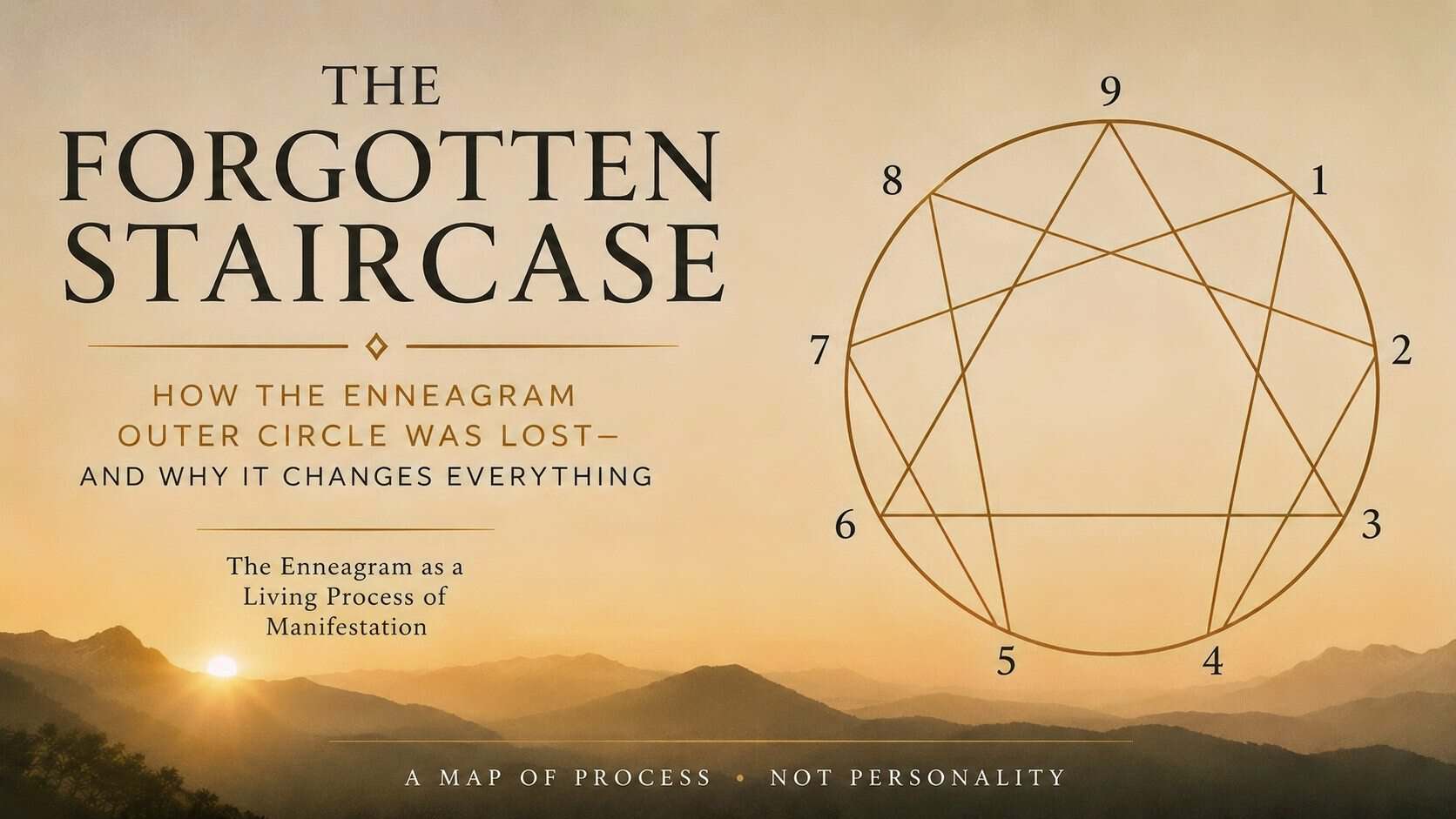
What If the Enneagram Was Never Primarily About Personality?
Most modern Enneagram teaching focuses on personality types, traits, motivations, defenses, wings, arrows, and behavioral patterns. For many students, coaches, and therapists, the Enneagram has become a system of psychological classification primarily. But that was not how G.I. Gurdjieff originally introduced the symbol.
In its earliest presentation, the Enneagram was not primarily a map of personality. It was a diagram of process — a living symbol describing how anything unfolds in time: a conversation, a meal, a business, a transformation, a human life, or an awakening.
At the center of that original teaching was something modern Enneagram literature has largely forgotten: the outer circle. This forgotten dimension of the Enneagram may be one of the most important missing pieces in contemporary Enneagram work.
What Is the Outer Circle of the Enneagram?
In Gurdjieff’s original teaching, the outer circle was not decorative. It was not merely a container holding nine personality types together inside a symbol of “unity” or “wholeness.” The outer circle represented the sequential unfolding of process in time.
Each point around the circumference described a stage in manifestation — a lawful movement within an unfolding octave. The Enneagram was not originally static; it was dynamic. It described movement, interruption, crisis, continuation, repetition, and transformation.
This completely changes the symbol’s meaning. The Enneagram was never simply describing who you are; it was describing how experience organizes itself.
How Did the Enneagram Become a Personality System?
Over the last fifty years, the Enneagram became increasingly identified with personality typology through the work of Oscar Ichazo, Claudio Naranjo, Don Riso, Russ Hudson, Helen Palmer, Beatrice Chestnut, and others.
This work brought enormous psychological insight and practical accessibility to the symbol. It helped millions of people understand patterns of identity, defense, attention, emotional fixation, and interpersonal behavior, but something profound was quietly lost in the transition. The outer circle gradually stopped functioning as a map of process and became little more than a frame surrounding nine personality styles. Meanwhile, the inner lines, originally expressions of lawful process, were repurposed into arrows of “integration” and “disintegration.”
The result was subtle but massive: the Enneagram shifted from a living symbol of manifestation into a psychological taxonomy.
What Did Gurdjieff Actually Teach About the Enneagram?
Gurdjieff described the Enneagram as a universal symbol of process. The circle represented the complete cycle of an unfolding phenomenon. The nine points represented the sequential stages through which that process moves. The inner triangle represented the Law of Three. The hexad represented the Law of Seven and the hidden intelligence moving within the process.
In other words:
- The outer circle describes manifestation in time
- The triangle described force
- The hexad described inner intelligence
These are not separate symbols; they are three simultaneous dimensions of one living process. Modern Enneagram teaching often collapses these distinctions together, flattening the symbol into a personality model while losing much of its original depth.
Why Are the Enneagram’s Shock Points So Important?
One of the most important dimensions of the original Enneagram teaching involves the shock points at 3 and 6.
In modern Enneagram teaching, these points are often interpreted symbolically or psychologically. In Gurdjieff’s original presentation, however, they represented interruptions in the lawful unfolding of process itself.
A process cannot continue on its own momentum; something additional is required. At specific intervals, new energy must enter the system, or the process loses coherence, repeats mechanically, collapses, or drifts sideways into compensation.
This insight has enormous implications for psychology, spiritual work, coaching, organizational development, nervous system regulation, and transformational practice because most human beings do not simply “change:” they repeat.
The shock points describe where repetition can either continue mechanically or reorganize into something genuinely new.
What Is Missing from Contemporary Enneagram Teaching?
What is largely missing today is a phenomenology of transformation.
Modern Enneagram teaching often excels at describing personality structure while remaining comparatively weak at describing how transformation actually unfolds in lived experience. The original process Enneagram addressed exactly that territory.
It described:
- stages of manifestation
- breakdown points in development
- interruption in process
- lawful continuation
- recursive repetition
- higher influences entering a system
- the relationship between consciousness and organization
- the difference between mechanical continuity and transformation
These questions are not peripheral to the Enneagram; they may be the original heart of the symbol itself.
Why Does This Matter for Coaches, Therapists, and Spiritual Teachers?
If the Enneagram is understood only as a personality model, then transformation tends to become self-improvement; the client learns better coping strategies, better communication, better emotional awareness, and better self-observation.
All of that has value, but personality refinement is not necessarily transformation. A process-oriented Enneagram shifts the focus from traits to organization itself. It asks:
- How is experience being constructed?
- What maintains fixation?
- What forces stabilize identity?
- Where does process lose energy?
- Where are the shock points?
- What allows a system to reorganize?
These questions move beneath personality description into the mechanics of manifestation itself. This is a radically different orientation to the Enneagram.
Can the Enneagram Become a Living Map of Transformation Again?
A growing number of contemporary thinkers are beginning to recover this lost dimension of the Enneagram.
While the personality-based Enneagram became dominant, a smaller Fourth Way stream continued preserving the Enneagram as a symbol of process. Writers such as J.G. Bennett and A.G.E. Blake maintained important aspects of this understanding, and more recently, Cynthia Bourgeault has helped reintroduce elements of the Enneagram’s process dimension to contemporary readers.
What remains largely undeveloped is a complete phenomenological map of the outer circle itself — a practical description of the stages, shocks, interruptions, and reorganizations involved in transformation as lived experience.
That territory remains astonishingly open. The forgotten staircase is still there. Most people simply stopped climbing it.