
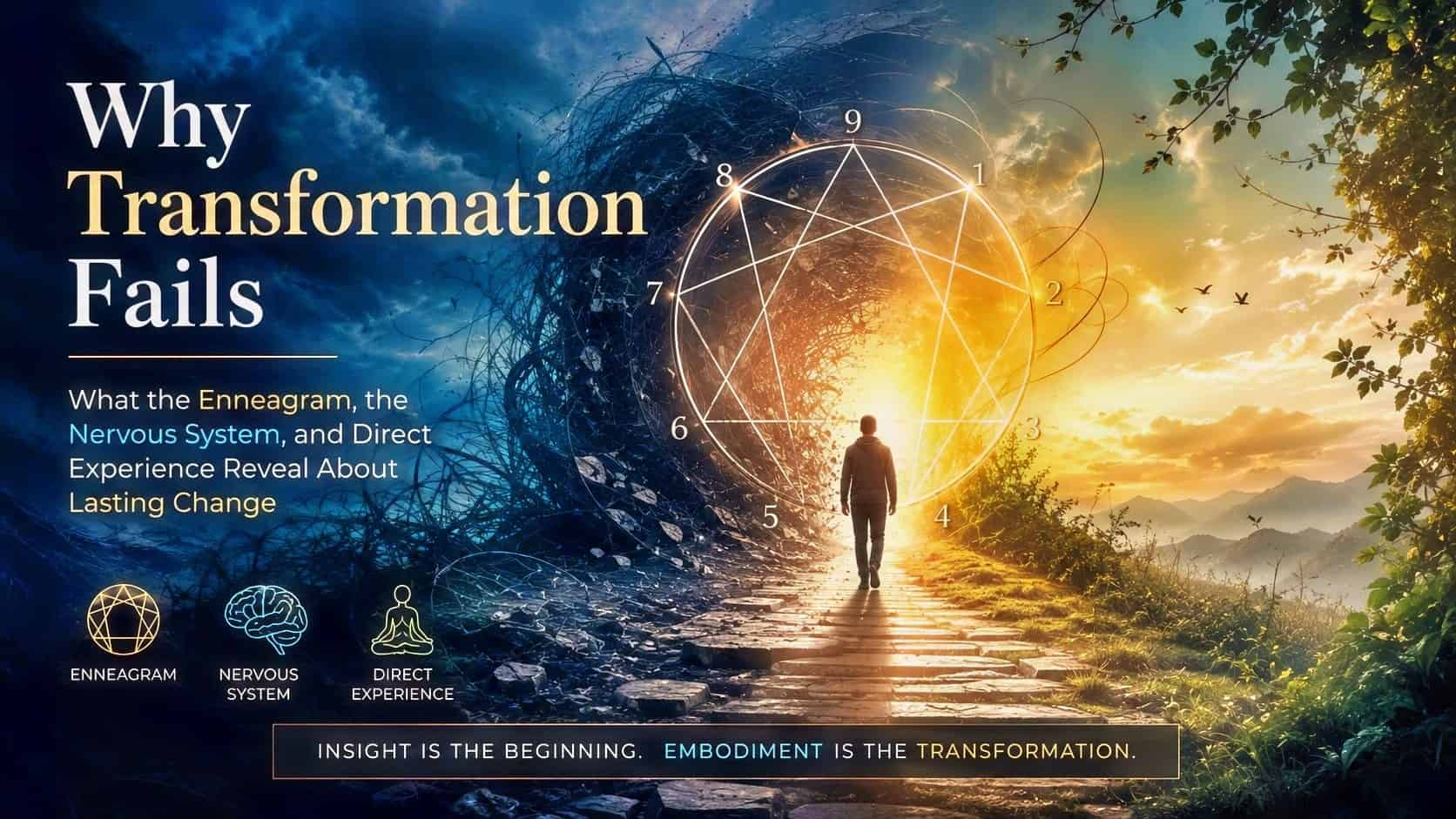
What the Enneagram, the Nervous System, and Direct Experience Reveal About Lasting Change
If insight created transformation, most of us would already be transformed, enlightened, and free of our Enneagram type.
We live in a culture saturated with information. We have access to books, podcasts, videos, workshops, therapy, spiritual teachings, and an endless stream of advice about how to become happier, healthier, and more fulfilled. Many people can explain their childhood wounds, identify their attachment style, name their Enneagram type, and describe their defensive patterns in remarkable detail.
Yet despite increased self-awareness, the same emotional reactions persist; the same relationship struggles emerge, the same fears return, and the same habits reassert themselves at precisely the moments we hoped they would not.
This raises an important question: Why does personal growth so often produce understanding without producing lasting change?
After more than five decades of spiritual practice, observation, inquiry, and teaching, I have come to believe that we are often looking for transformation in the wrong place.
Why Self-Awareness Doesn’t Automatically Create Change
Most approaches to personal development focus on the contents of consciousness. We examine our thoughts, emotions, beliefs, stories, memories, and behaviors. While this can be enormously valuable, it often overlooks a deeper reality.
The patterns that govern our lives do not exist solely in the narrative mind; they exist in the body, in the nervous system, and in habitual ways of perceiving, responding, protecting, and organizing experience.
This helps explain why insight alone frequently fails. The mind may understand the pattern while the organism continues to recreate it. We know better, yet we continue to do what we have always done because the structures generating our experience remain largely unchanged.
Transformation requires more than understanding; it requires participation with the living process that is creating our experience moment by moment.
The Enneagram Beyond Personality Types
Most people encounter the Enneagram as a system of nine personality types. While this has value, it is only a small part of what the symbol was originally intended to represent.
The modern Enneagram is often used to help people understand themselves. The deeper Enneagram helps people understand the processes through which experience itself is organized.
This distinction is profound. Instead of asking, “What type am I?” we begin asking, “What process is operating right now?”
Instead of treating personality as identity, we begin to recognize it as a recurring pattern of organization. Personality becomes less a description of who we are and more a description of how experience habitually arranges itself when direct contact with our deeper nature is obscured.
The Enneagram then becomes less a box and more a map of movement.
The Shape of Absence
One of the central observations that runs throughout my work is that personality is not simply a collection of traits; it’s the shape of absence. Every personality structure develops around a particular interruption in our relationship with Being.
- Certain qualities become less available.
- Certain capacities become obscured.
- Certain ways of experiencing ourselves and the world become difficult to access.
In response, we develop strategies, create identities, construct narratives, and establish patterns of perception and behavior designed to compensate for what appears to be missing. Over time, those strategies become so familiar that they feel like who we are. Yet what if personality is not our true identity? What if it is the adaptive structure built around forgetting?
This possibility changes the entire conversation about transformation.
Why Spiritual Growth Often Stalls
Many sincere spiritual seekers eventually encounter a plateau. They have powerful experiences, gain important insights, and understand profound teachings. Yet the deeper structures of suffering often remain surprisingly intact.
The reason may be that awakening and transformation are not identical. Insight can reveal truth, realization can illuminate reality, a moment of awakening can disclose our deeper nature, yet the organism itself may still be organized around old patterns.
- The nervous system may continue anticipating threat.
- The body may continue holding contraction.
- The personality may continue recreating familiar forms of experience.
Lasting transformation occurs when realization begins to penetrate these deeper levels of organization.
The Missing Role of the Nervous System
Recent developments in trauma research, attachment theory, polyvagal theory, and somatic psychology have provided valuable insight into why change is often so difficult. Human beings are not merely psychological creatures. We are biological organisms whose histories become embedded within our physiology.
- Our bodies remember.
- Our nervous systems learn.
- Our emotional responses become conditioned.
Our perceptions become organized around expectations developed long before we had language to describe them. This understanding does not diminish spirituality. It enriches it.
Transformation becomes less about transcending our humanity and more about fully inhabiting it. Spiritual realization and nervous-system regulation cease to be separate conversations and become aspects of the same developmental process.
A New Map of Transformation
The five books comprising The Inner Architecture of Transformation explore this territory from different perspectives.
Why Study Personality? challenges the assumption that growth is primarily about self-improvement.
The Alchemy of Perception investigates how perception itself participates in constructing reality.
The Enneagram as Living Process restores the Enneagram to its role as a dynamic symbol of transformation, rooted in the Law of Three and the Law of Seven.
The Enneagram & The Arc of Transformation examines the actual phenomenology of change, revealing why insight often fails and how deeper reorganization becomes possible.
Enneagram Shock Points explores the biological dimensions of transformation, showing where psychological structures meet nervous-system realities.
Together they form a developmental continuum moving from personality, to perception, to process, to transformation, and ultimately to embodiment.
The Real Question
The real question is not how to become a better version of ourselves, the real question is whether the structures that continually recreate our familiar experience can become transparent enough for something deeper to emerge.
Every authentic spiritual tradition points toward this possibility. The Enneagram, when understood as a living process rather than a personality system, offers a remarkable map of that journey.
The path begins with self-observation. It deepens through inquiry. It unfolds through participation. Eventually, it reveals something unexpected. The goal was never to perfect the personality, The goal was to discover what remains when personality is no longer the center of gravity.
The Inner Architecture of Transformation
If you have reached the limits of self-improvement, if self-awareness has brought understanding without freedom, or if you sense that lasting change must involve the body as much as the mind, this work was written for you.
The journey does not move upward toward a perfected self. It moves inward toward direct experience, downward into embodiment, and ultimately beyond the structures that once defined who we believed ourselves to be.
Transformation begins where self-improvement ends.