
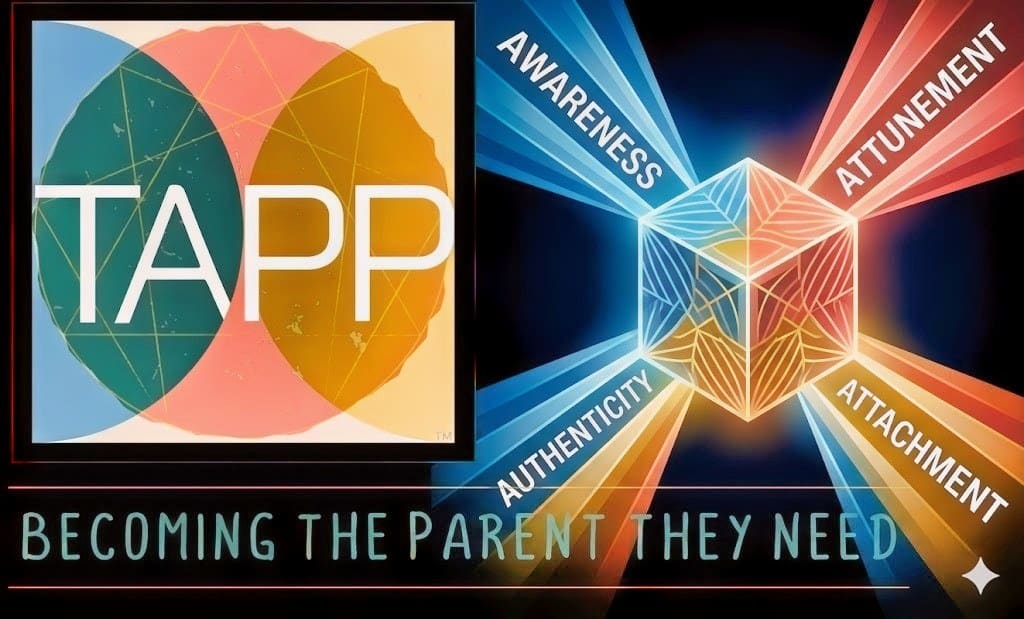
The core purpose of this article is to introduce parents to the foundational paradigm of The Attuned Parent Project (TAPP). In a parenting culture flooded with behavioral hacks, sleep training formulas, and hyper-curated milestones, TAPP offers an alternative: a return to relationship, presence, and authentic seeing.
The goal of our work is not to train children to comply, but to support parents in cultivating the self-awareness necessary to raise whole, resilient human beings.
Raising Consciousness, Not Just Children
Most modern parenting advice operates under a flawed premise: that children are passive projects to be managed, shaped, and optimized. This approach instrumentalizes daily life, transforming ordinary moments into performance metrics.
TAPP stands on a fundamentally different foundation. We view parenting not as a set of techniques to master, but as a reciprocal, living process of mutual transformation. The child is not an empty slate; they arrive with an inherent, unconditioned wholeness, an essence that includes their natural capacity for joy, peace, strength, and will.
The vision of TAPP is built upon four foundational pathways of becoming:
- Awareness: Cultivating a clear, non-judgmental attention that sees the reality of the present moment rather than our projections.
- Attunement: Meeting a child exactly where they are somatically and emotionally, rather than where our expectations demand them to be.
- Attachment: Providing a reliable, secure emotional ground that serves as a safe haven for returning and a launchpad for exploration.
- Authenticity: Honoring the child’s unique nature and voice, resisting the cultural impulse to force them into a mold of social compliance.
When parents engage these four pathways, they stop managing behavior from the outside and begin relating to the child’s living soul from the inside.
Why Strategies Fail and Presence Heals
When a parent relies on formulaic scripts or clinical techniques, such as delivering a perfectly worded boundary while their own nervous system is tight with unexpressed anger or anxiety, the child completely ignores the words. Children do not experience life conceptually; they experience it energetically and somatically. They read the micro-contractions in our bodies, the hidden edge in our tone, and the absence of our attention.
When a child’s natural emotional expressions meet chronic parental reactivity, the child’s organism instinctively contracts to protect itself. Over time, these repeated somatic contractions crystallize into behavioral patterns and psychological defenses, eventually veiling the child’s direct access to their own essence.
This is why TAPP focuses heavily on the parents’ inner ecology. If we cannot tolerate our vulnerability, we will unconsciously suppress our child’s softness. If we are terrified of conflict, we will neutralize our child’s healthy self-assertion. The parents’ willingness to face their emotional triggers and somatic patterns is the true curriculum of parenting.
Evidence from the Developmental Field
The principles of TAPP are not idealistic spiritual abstractions; they are deeply anchored in decades of established psychodynamic and developmental research. The intersection of clinical theory and somatic presence demonstrates how a child constructs their sense of self:
- The Holding Environment: D.W. Winnicott’s research shows that a child’s “true self” only emerges when their spontaneous gestures are met with reliable, attuned emotional containment. Without this clear containment, a child constructs a compliant “false self” to manage the environment.
- The Psychological Birth: Margaret Mahler’s foundational work on the separation-individuation process charts how a child moves from early symbiotic oneness into distinct individual selfhood. This journey requires a parent who can serve as a steady “secure base,” allowing the child to pull away into autonomy and return for emotional refueling without fearing a loss of connection.
- The Relational Blueprint: John Bowlby’s attachment theory holds that our earliest relational bonds form enduring internal working models within the nervous system, shaping how safe we feel in the world and how we connect with others for the rest of our lives.
A deeper exploration of these stage-specific transitions and their psychological mechanisms can be found in Nurturing Essence, while a comprehensive structural look at how family ecosystems directly influence these developmental arenas is detailed in Enneagram World of the Child. These books establish that healthy psychological architecture is forged through the everyday quality of relational attunement.
The Practice of Essential Mirroring
To support a child’s development without driving their inherent nature underground, parents must practice what TAPP calls essential mirroring. Conventional parenting thrives on conditional approval or identity-labeling praise, calling a child “a good helper” or “the smart one”. These labels lock children into rigid behavioral masks, forcing them to perform a specific image to keep securing acceptance.
Essential mirroring is a radical departure from conventional praise. It is often wordless, rooted in simple, spacious witnessing. It requires the parent to slow down, drop below their conceptual mind, and accurately reflect the deeper quality of being moving through the child in the present moment.
- Instead of praising a completed puzzle to encourage achievement, we mirror the steadiness of personal will and determination they displayed as they worked through the frustration.
- Instead of reinforcing compliance when they are quiet, we celebrate their capacity for inner peace and groundedness.
This form of recognition does not evaluate performance; it affirms existence. It lets the child know, at a cellular level, that they are seen, known, and loved for who they are, not for what they do.
Turning Judgment Into Curiosity
The ultimate realization of the TAPP framework is that our children are not distractions from our personal or spiritual work; they are the work. They operate as exquisite mirrors, reflecting our unhealed wounds, our rigid control strategies, and our forgotten places back to us.
When parenting brings us to our knees, when a boundary fails, a tantrum escalates, or a routine breaks down, TAPP invites us to step out of reactive judgment and step into open curiosity. Instead of demanding that the child change, we ask, “What is happening in my body right now?” What old pattern is this triggering? How can I meet this chaos with presence rather than conditioning?
By choosing reflection over reactivity, we stop the automatic transmission of historical baggage. We clear the space for our children to build a functional, healthy personality that remains transparent to the depth of who they truly are. This is the sacred opportunity of TAPP: to transform ourselves so that our children have the freedom to remain whole.
Professional Consultation and Community Engagement
To learn more about the ongoing work of the project, register for our upcoming parenting initiatives, or discover community groups dedicated to this path of relational attunement, visit the official TAPP portal.