I was reading this article in Neuroscience News about a recent study on memory and the medial temporal lobe, and it sparked a cascade of associations—threads weaving together ancient chanting traditions, modern sound apps, biophoton research, and the deep cosmological insights of Walter Russell, Jacobo Grinberg-Zylberbaum, and others.
The researchers find that nerve cells in this core memory hub synchronize their firing to produce slow brain waves, known as theta oscillations, during both learning and recall. These 4–8 Hz rhythms act less like a simple “on/off” switch for remembering and more like the conductor’s baton, setting the tempo for the brain’s memory orchestra.
Theta waves are a signature of deep yet alert states—moments when the mind turns inward, the body relaxes, and perception opens into a receptive, immersive field. We experience them in the hazy borderlands between waking and sleep, during immersive creativity, or in meditation. Many chanting and mantra practices naturally evoke theta activity, aligning the nervous system with a slower, more integrative rhythm. In neuroscience, theta waves coordinate communication between the hippocampus and the cortex—exactly the synchrony needed for both memory formation and retrieval.
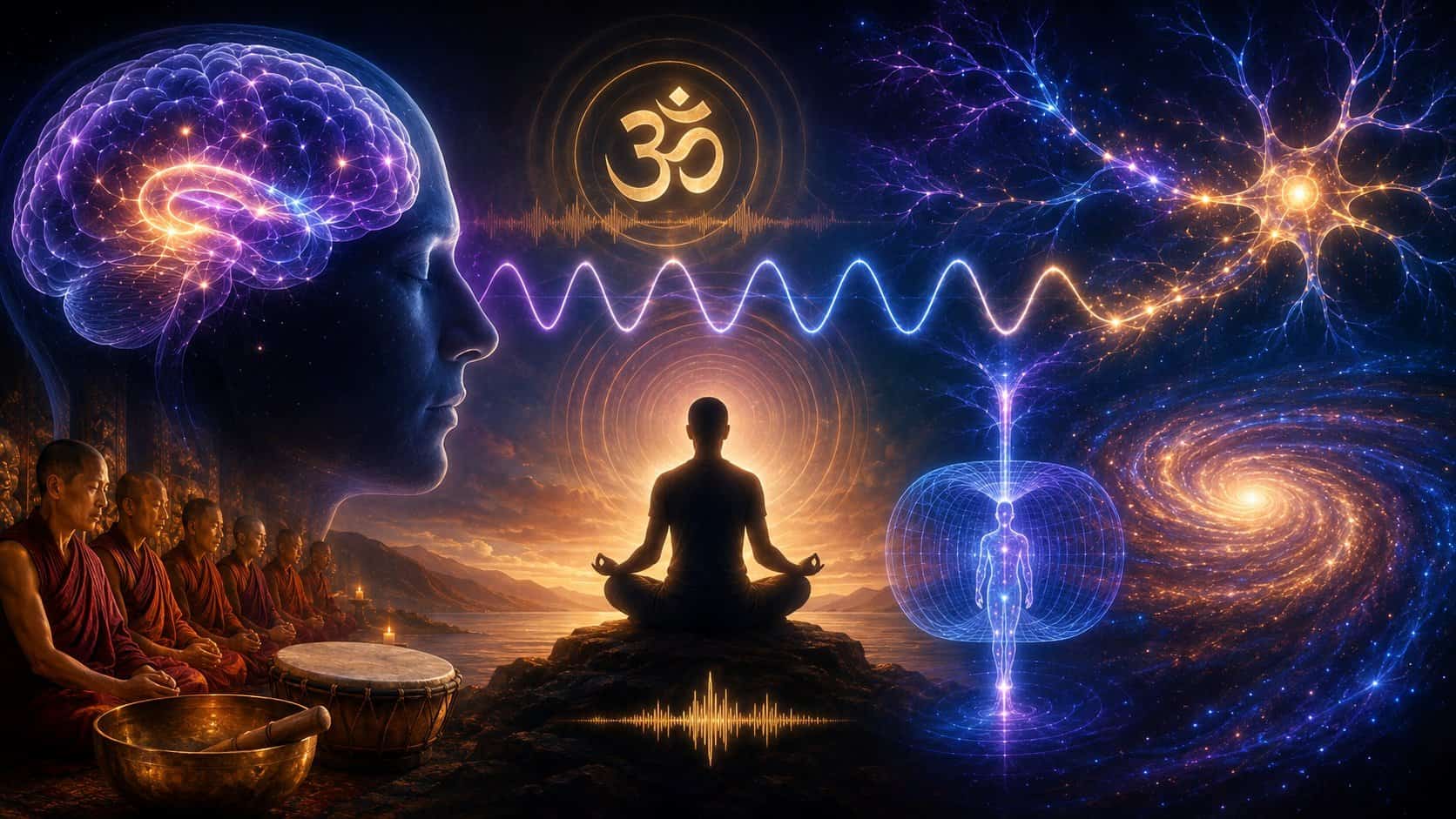
In Good Vibrations: Primordial Sounds of Existence, we explore how sound—whether voiced, struck, or resonated—entrains human consciousness to these deeper rhythms. Chanting “OM” or “HU,” rhythmic drumming, or even modern binaural beats all influence the body’s natural oscillations. The medial temporal lobe’s theta rhythms are one of the key meeting points where vibration and memory converge, where the body’s resonance chamber meets the mind’s pattern-making. Reading Good Vibrations opens this world in detail, connecting the science of sound to the lived, felt experience of vibration in meditation, ritual, and daily life.
The Quantum & Light Connection
Earlier research has shown that neurons emit ultra-weak, coherent light called biophotons—a finding that suggests the brain may use a light-based channel for information processing ([link to your earlier biophoton post goes here]). If theta rhythms are the master clock of the medial temporal lobe, they may not only organize electrical firing patterns but also optimize the conditions for coherent biophoton emission. In other words, when neurons fire in synchrony at theta frequency, they might “open the channel” for photonic communication, allowing the brain’s light signals to become more precise and meaningful.
Walter Russell describes the universe as a rhythmic, balanced interchange of electric waves, a cosmic heartbeat shaping matter and thought alike. If the brain truly uses biophotons, then theta rhythms could be our local resonance with that universal oscillation—a microcosmic echo of the same wave pattern that structures the cosmos.
Jacobo Grinberg-Zylberbaum’s Syntergic Theory envisions consciousness as a holographic interaction between the brain and a universal field. In holography, only coherent light can reconstruct a full image; in the brain, only coherent rhythms—perhaps theta-locked, biophoton-enabled states—may fully access and integrate the deeper layers of reality.
The Role of Chanting
From this perspective, chanting is not simply a devotional act or mental aid—it is a precision tool for tuning the brain’s oscillations and light emissions to optimal coherence. Each repetition acts as a metronome tick, each vibration as a carrier wave, each breath cycle as a harmonic that stabilizes the whole system. Whether you are a Tibetan monk intoning mantras, a Sufi chanting “Allah,” or a modern meditator using a sound app, you are engaging the same ancient mechanism: aligning neural rhythms, photonic emissions, and universal waves into one continuous resonance.
An Invitation
In “Good Vibrations,” we explore how these primordial sounds are embedded in the very structure of existence itself. This new research is another piece of the puzzle: the brain does not simply store memories—it orchestrates them in time, possibly using both electrical and photonic coherence. The same universal tempo that shapes galaxies may beat quietly in our skulls, waiting for us to listen, hum, and remember.