
Can the Enneagram illuminate the journey from False Self to True Self?
When I wrote The Enneagram & the Arc of Transformation, I was interested in a simple question: “If the Enneagram is understood as a map of process rather than a typology of personalities, does it illuminate the transformational journey described by the Diamond Approach®?”
Later, I asked a similar question about Buddhism and later about Sufism. Although these traditions emerged from very different cultures and use very different languages, placing them alongside the Enneagram revealed a number of striking correspondences and distinctions. The value of the comparison did not lie in proving that the traditions were saying the same thing; it lay in allowing each perspective to illuminate aspects of the others that might otherwise remain unnoticed.
That exploration naturally raises another question: “What happens if we place psychotherapy beside the Enneagram as Living Process?”
At first glance, the comparison appears less obvious. Psychotherapy is not primarily concerned with enlightenment, liberation, or realization; it’s concerned with human suffering as it appears in everyday life. People seek therapy because anxiety has become overwhelming, relationships continue repeating painful patterns, grief remains unresolved, trauma refuses to loosen its grip, or life simply no longer feels authentic. The therapeutic enterprise is profoundly practical; it seeks to reduce suffering while increasing psychological health, emotional resilience, and the capacity to participate more fully in life.
That accomplishment deserves enormous respect.
Modern psychotherapy has transformed our understanding of attachment, development, trauma, emotional regulation, and the extraordinary adaptability of the human nervous system. It has demonstrated that personality is neither fixed nor condemned to endlessly repeat its history. People change; relationships change; and ways of experiencing oneself and the world change. These are not small achievements; they have improved the lives of millions of people.
Nothing in this inquiry should be understood as diminishing those contributions; in fact, the opposite is true.
The purpose of this article is to explore whether the therapeutic process follows a recognizable pattern when viewed through the Enneagram as Living Process. The question is not whether therapists should use the Enneagram, nor whether Gurdjieff anticipated contemporary psychology. The question is whether two very different ways of observing human development might be describing the same underlying architecture of change.
Before beginning, one distinction needs to remain clear throughout the discussion: psychological change is not the same as spiritual transformation.
Donald Winnicott’s distinction between the False Self and the True Self provides an ideal framework for the exploration that follows because his work remains entirely within the psychological domain. The therapeutic movement he describes is a movement from defensive adaptation toward increasing authenticity. The personality does not disappear. Identity does not shift beyond the psyche. The person becomes increasingly alive, spontaneous, resilient, and capable of living from what Winnicott called the True Self.
That, by itself, is an extraordinary developmental achievement.
Contemplative traditions eventually ask a different question: they inquire into the nature of the self itself. Whether that inquiry ultimately extends beyond psychological identity is a matter for another article. Our concern here is entirely therapeutic. We are asking whether the movement from suffering toward psychological health unfolds in accordance with the lawful process represented by the Enneagram as a universal symbol of process.
Rather than beginning with personality styles or therapeutic techniques, it may be more useful to begin where therapy itself begins.
It begins with the organism.
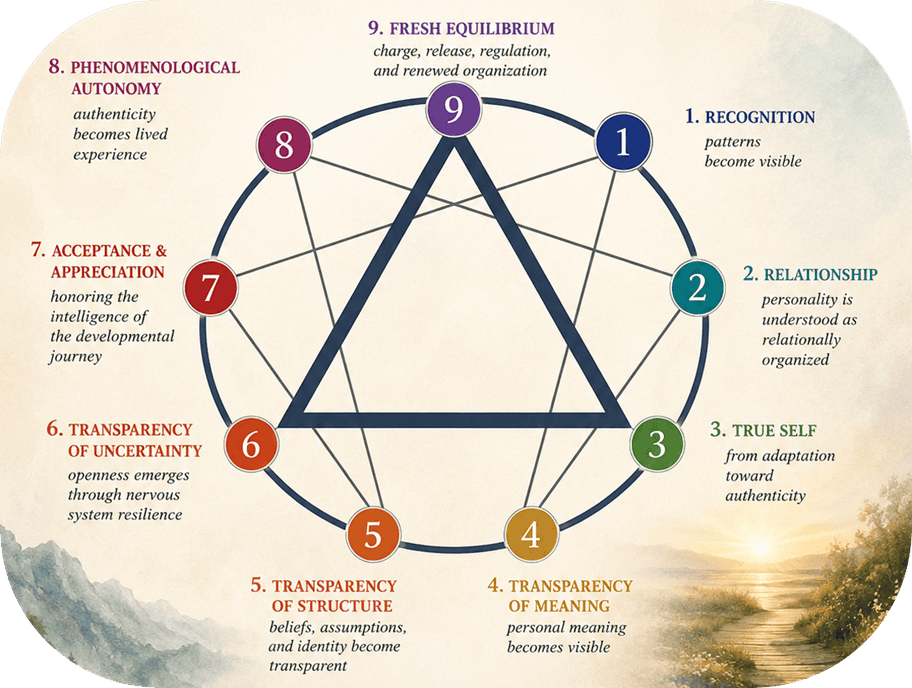
Point Nine — Equilibrium
One of the smaller discoveries of modern psychology is that meaningful change rarely begins with insight. Most people assume that if they could simply understand themselves well enough, they would naturally change. Experience consistently demonstrates otherwise. A person may understand the origins of their anxiety, recognize the childhood events that shaped their personality, and even identify the beliefs that continue organizing their experience, yet find themselves responding in remarkably familiar ways when life becomes emotionally charged.
Understanding alone does not reorganize the psyche; something more fundamental must occur before insight can become transformative within the psychological domain.
The nervous system must first develop sufficient stability to remain present with experience without immediately organizing itself around survival. A person living in continual states of hypervigilance, emotional flooding, collapse, or dissociation possesses very little capacity for sustained inquiry because nearly all the organism’s resources are devoted to maintaining equilibrium. Reflection becomes difficult when survival occupies the foreground of experience.
This observation suggests an intriguing correspondence with the beginning of the Enneagram process.
If Point Nine represents the condition from which development begins, then psychotherapy appears to require its own version of Point Nine. Within the therapeutic domain, however, this point is perhaps understood less as Presence in the contemplative sense and more as equilibrium. The organism develops sufficient regulation, resilience, and internal safety for experience to begin to reveal itself without immediately requiring defensive organization.
Equilibrium should not be confused with the absence of difficulty. In fact, many people begin therapy during periods of profound emotional upheaval. What gradually develops is not a life free of activation, but an increasing capacity to remain psychologically organized while activation occurs. The window of tolerance (Siegel) widens; emotional regulation becomes more reliable; recovery from stress becomes quicker; and experiences that once overwhelmed the system become increasingly workable because the nervous system itself has matured.
Over time, the individual develops a greater capacity for autonomous regulation. The therapeutic relationship may initially provide much of the stability that makes this possible. The consistent presence of another human being who remains curious, attuned, and emotionally available gradually becomes internalized. Regulation that was once borrowed increasingly becomes one’s own. The individual develops the capacity to observe thoughts, feelings, and bodily experience without immediately becoming organized by them.
This movement is subtle.
People often imagine psychological growth as dramatic breakthroughs or life-changing insights. More commonly, it appears as increasing steadiness. One discovers a little more room around difficult emotions. Reactions that once occurred instantly become slightly slower. Curiosity occasionally appears where certainty once dominated. The organism begins demonstrating a steady confidence that it can remain present with experiences that previously demanded immediate escape or control.
If this observation is accurate, another question naturally follows: “Once sufficient equilibrium has been established, what is it that the psyche begins observing?”
It does not begin by asking who it truly is; it begins by recognizing the patterns through which it has been living.
Point One — Recognition
Therapeutic work often begins with a deceptively simple discovery: what once appeared to be isolated problems gradually reveals itself as an organized pattern. Anxiety is no longer experienced as something that randomly appears from nowhere. Conflict in relationships is no longer viewed as bad luck. Emotional withdrawal, perfectionism, people-pleasing, chronic self-criticism, or controlling behavior gradually begin revealing an internal coherence. What once seemed like separate difficulties are recognized as different expressions of the same underlying organization.
This shift from reaction to recognition represents one of the first genuine movements of therapy. If experience is lived unconsciously, there is very little freedom because each situation appears unique and demands an immediate response. Once patterns become visible, however, something changes. The individual begins to recognize that today’s reaction is remarkably similar to yesterday’s, and that both resemble responses repeated for years, perhaps even decades.
This recognition is rarely experienced as an abstract insight; it’s often accompanied by surprise, humility, and, occasionally, grief. Many people discover that they have been living inside psychological organizations they never knew existed. What they assumed was simply “who I am” begins revealing itself as a predictable way of organizing perception, emotion, and behavior.
Therapy begins replacing unconscious repetition with conscious observation.
This movement should not be confused with self-criticism. Recognition is not another opportunity to judge oneself more harshly. Quite the opposite. The purpose of recognition is to observe without immediately correcting, defending, or explaining. Curiosity gradually replaces certainty because the individual begins sensing that these patterns must have developed for reasons that once made sense, even if they no longer serve the same function today.
This naturally leads to another question.
If these recurring patterns are not random, where did they come from? Why do particular emotional reactions organize themselves in these specific ways while other possibilities remain largely unavailable? Recognition alone cannot answer these questions. It simply reveals that there is something deeper to investigate.
That investigation naturally leads toward relationship.
Point Two — Relationship
Psychotherapy has repeatedly demonstrated that personality does not develop in isolation. The psychological organization we eventually call “ourselves” emerges within relationship long before we possess the capacity to consciously understand what is taking place. Parents, siblings, caregivers, teachers, and the family’s emotional atmosphere all participate in shaping the developing psyche. Over time, these relationships become internalized until they no longer appear as relationships at all; they become the lens through which later experience is interpreted.
Recognition expands into relationship.
The question is no longer simply, “Why do I keep reacting this way?” It gradually becomes, “How did this way of organizing experience develop?” A person’s fear of criticism may begin to make sense when viewed in the context of a highly critical parent. Chronic self-reliance may reveal itself as an adaptation to emotional neglect. The continual need to anticipate others’ moods may once have been an intelligent strategy within an unpredictable family system. Patterns that initially appeared irrational begin revealing an extraordinary developmental intelligence.
This is one of psychotherapy’s most compassionate discoveries: many of the qualities we later experience as symptoms were originally acts of adaptation. They were attempts by a developing organism to preserve continuity under conditions that exceeded its capacity to respond in healthier or more self-aware ways. The child did not choose these organizations through careful reflection. The nervous system learned them because they worked well enough to preserve relationship, reduce danger, or maintain psychological survival.
Seen from this perspective, the False Self begins acquiring an entirely different meaning.
Rather than viewing it as something artificial or deceptive, it becomes possible to appreciate it as an ingenious developmental achievement. Winnicott understood that adaptation itself is not pathological. Every child must adapt to the environment in which they are born. Difficulties arise only when adaptation becomes so dominant that spontaneity, authenticity, and direct contact with experience gradually disappear beneath the effort required to maintain those adaptations.
If personality is organized through relationship, perhaps it can also be reorganized through relationship. The therapeutic alliance becomes far more than a conversation about problems. It becomes a living relational environment within which new experiences become possible. Trust slowly replaces vigilance; emotional expression becomes safer; curiosity becomes stronger than self-protection. The nervous system begins discovering that it no longer must organize itself exactly as it once did because the relational conditions have fundamentally changed.
As these new experiences accumulate, another movement begins to take shape: the individual no longer sees only adaptations; they begin to discover the person who has been living beneath them.
Point Three — False Self to True Self
It is here that Winnicott’s work offers one of the clearest descriptions of the therapeutic process: if the first movement of therapy establishes sufficient regulation to support inquiry, the second recognizes recurring patterns, and the third understands how those patterns were organized through relationship, another possibility begins to emerge. The individual gradually discovers that adaptation, however intelligent and necessary it may have been, is not the whole of who they are.
Winnicott called this distinction the False Self and the True Self.
The False Self has often been misunderstood as something fraudulent or inauthentic, as though it were simply a mask hiding a more genuine person beneath it. Winnicott’s understanding is considerably more subtle. The False Self develops because every child must learn to adapt to the demands of the environment. Parents have expectations; families have emotional climates; schools have rules; and society has values. Development requires an extraordinary capacity to respond to what is needed while preserving sufficient continuity for a stable personality to emerge.
The difficulty arises when adaptation gradually becomes the primary mode of living. Instead of expressing spontaneous experience, the individual increasingly organizes life around maintaining acceptance, avoiding conflict, preserving attachment, or securing approval. What originally served development eventually begins constraining it. Personality becomes organized less around direct participation in life and more around managing the conditions under which life feels psychologically safe.
This distinction helps explain why many people arrive in therapy with lives that appear successful while privately experiencing a persistent sense of emptiness or disconnection. They may have satisfying careers, stable relationships, and considerable competence, yet still feel that they are performing their lives rather than inhabiting them. Something feels absent, though they often struggle to describe exactly what it is.
The therapeutic process gradually reveals that what has been missing is not achievement, but spontaneity. It is the felt sense of being able to respond directly from one’s experience rather than continually filtering that experience through strategies of adaptation that were developed many years earlier.
The movement toward the True Self is not a movement toward perfection, nor is it a movement toward some idealized version of oneself; it’s a gradual recovery of authenticity. Emotional life becomes more immediate because feelings no longer require continual management before they can be experienced. Relationships become more reciprocal because they are less organized around unconscious accommodation. Creativity expands because expression is no longer dominated by the need to preserve one’s self-image.
From the perspective of psychotherapy, this is not a preliminary stage awaiting something more important; it’s one of the central achievements of therapeutic work. A coherent, resilient, emotionally alive personality represents an extraordinary developmental accomplishment. The False Self has not been defeated; it has been understood, appreciated, and gradually reorganized into a healthier expression of psychological life.
At this point, another question naturally emerges: “If the personality has become increasingly coherent and authentic, what happens next?”
Many people assume that therapy has now reached its conclusion. Symptoms have diminished; relationships have improved; emotional regulation has deepened; and life feels more genuine. Yet therapists often observe that something else begins to happen at precisely this stage: the individual no longer relates to experience in the same way because the personality itself has become capable of examining its own organization.
The inquiry subtly changes.
Instead of asking, “Why do I react this way?” the person begins asking, “Why does this experience mean what it means to me?” They become interested not only in their thoughts and emotions but also in the process by which those thoughts and emotions acquire their significance. The personality begins turning its attention toward itself with increasing clarity.
Perhaps this is where another movement of the Enneagram begins to reveal itself: what unfolds through the next three points is not simply greater insight; it’s an increasing transparency into psychological life.
The structures of personality remain fully present, yet they gradually become more visible to the person who is living them. Meanings become less absolute, beliefs become more flexible, and assumptions begin revealing themselves as assumptions rather than objective descriptions of reality. This growing transparency is accompanied by the continued maturation of the nervous system, which now possesses greater resilience, greater emotional range, and a deeper capacity to remain present with experiences that would once have required immediate defensive organization.
The therapeutic journey has entered a new phase; it’s no longer primarily concerned with constructing a healthier personality but with helping that personality become increasingly transparent to itself.
The Arc of Transparency
One of the assumptions quietly shared by many approaches to psychotherapy is that insight produces change. There is certainly truth in this observation, yet anyone who has spent time in therapy eventually discovers its limitations. We can understand why we become anxious, recognize the origins of our self-criticism, identify the family dynamics that shaped our personality, and still find ourselves reacting in remarkably familiar ways. It is maintained by meanings, emotions, bodily responses, habits of attention, and the nervous system.
Perhaps something more fundamental is taking place. Perhaps the deeper movement through this phase of therapy is not the accumulation of insight but the gradual increase in transparency. The personality does not become less organized; it becomes progressively more visible to itself. Structures that once operated automatically begin revealing the ways in which they organize experience. The individual is no longer completely immersed in the psychological process; they begin participating consciously in it.
This movement appears to unfold through three closely related stages.
Point Four — Transparency of Meaning
Every personality organizes itself through meaning.
Experiences are never simply remembered; they are interpreted. A parent’s criticism becomes evidence that “I am never good enough.” Emotional neglect becomes proof that “My needs are too much.” Repeated disappointment gradually becomes “People cannot be trusted,” while success may become “I must always perform.” These conclusions are rarely the result of deliberate reasoning; they emerge naturally within the emotional world of the developing child and gradually become woven into the structure of identity.
Over time, these meanings become almost invisible because they are experienced as reality. We no longer notice the interpretation because we are looking through it. The world appears self-evident precisely because the meanings organizing our perception have become transparent in the wrong sense. We do not see them; we see through them.
Therapeutic inquiry gradually shifts from What happened? to Why has this come to mean what it means to me? That small change in emphasis has enormous consequences because it begins to separate the event from its interpretation. The person discovers that the emotional conclusions that organized the experience were not inevitable. They were intelligent developmental constructions that made sense within a particular history.
Meaning begins to become transparent.
Nothing has been removed; memories, relationships, and the past remain. What changes is the unquestioned authority of the meanings that have organized them. The emotional glue binding those interpretations together begins softening, allowing experience to become increasingly available to fresh understanding.
Point Five — Transparency of Structure
As meanings become more transparent, another capacity naturally begins to mature: the individual gradually develops the ability to observe not only particular thoughts or emotions but also the structures through which those thoughts and emotions are continually organized. This is a very different form of reflection from simple self-analysis. The person begins recognizing beliefs as beliefs, assumptions as assumptions, and internalized voices as internalized voices. Psychological structures that once appeared indistinguishable from reality become observable.
This marks the beginning of a healthy process of disidentification.
Disidentification is often associated exclusively with contemplative practice, yet psychotherapy reveals its own form of this movement. The individual does not cease having beliefs or narratives. Rather, they are no longer completely fused with them. “This is how I learned to understand myself” gradually replaces “This is who I am.” The distinction may appear subtle, yet it transforms the relationship between the person and their psychological life.
The personality has not become weaker; it has become more transparent.
This transparency allows the True Self to participate consciously in its organization rather than be unconsciously governed by it. The individual begins to recognize that personality is not a fixed object but a living process that continually organizes thoughts, emotions, memories, and relationships into a coherent experience of self.
Point Six — Transparency of Uncertainty
As fixed meanings and unquestioned assumptions gradually lose their authority, something unexpected begins happening; certainty softens.
Earlier in development, uncertainty often felt dangerous because the nervous system depended upon familiar interpretations to preserve stability. Even painful conclusions could feel safer than not knowing because they provided continuity. As therapeutic work matures, the organism develops sufficient resilience that ambiguity no longer carries the same threat.
This is not because uncertainty has become pleasant; it’s because the nervous system has changed.
Greater emotional regulation, increased affect tolerance, and a broader capacity for self-observation allow the individual to remain present as old organizations continue to reorganize. Questions no longer demand immediate answers, and emotional experience no longer requires instant interpretation. The future becomes more open because it no longer must be constructed from the same psychological conclusions that organized the past.
What has changed throughout this movement is not simply understanding; the individual now inhabits their interior life differently. They are more intimate with their experience, more sensitive to the subtle ways personality organizes itself, and more capable of remaining present as that organization continues to evolve. Transparency has become both a psychological and a physiological reality because the maturation of the nervous system has made possible levels of emotional contact that previously would have been overwhelming.
That transparency prepares the way for another movement altogether. As the psyche becomes less occupied with defending itself against its history, enormous amounts of psychological energy become available. The question gradually shifts from understanding the past to participating more fully in life, and that participation begins with a surprisingly simple movement: the individual begins appreciating the journey that brought them here.
Point Seven — Acceptance and Appreciation
There is a quiet turning point that often appears after years of therapeutic work; it’s rarely dramatic and seldom receives the same attention as insight or an emotional breakthrough, yet it changes the entire emotional atmosphere of the journey: the individual begins to relate differently to their history.
Earlier in therapy, much of the work naturally centers on understanding what happened, recognizing how early experiences shaped the developing personality, and grieving what was absent or wounded. These movements are essential because they make previously unconscious organization visible. As transparency increases, another possibility gradually emerges: the past is no longer experienced primarily as something that must be repaired; it begins to be understood as the developmental path through which the present person came into being.
Acceptance begins replacing resistance.
This acceptance should not be confused with approval. To accept one’s history is not to suggest that abuse was beneficial, neglect was appropriate, or suffering was somehow necessary. Rather, acceptance reflects the growing recognition that the past cannot be separated from the person who now possesses the capacity to understand it. Every adaptation, every disappointment, every success, every wound, and every discovery participated in the formation of the personality that has become capable of reflection.
The emotional tone of the work changes in subtle but important ways.
Self-judgment gradually softens into compassion as the individual begins to recognize the extraordinary intelligence of psychological development. Patterns that once appeared only as obstacles reveal themselves as creative adaptations that allowed life to continue under circumstances that exceeded the resources available at the time. The False Self is no longer experienced as an adversary to overcome; it becomes possible to appreciate it as an expression of the organism’s determination to preserve continuity until greater capacities could emerge.
This appreciation has profound psychological consequences because it releases an enormous amount of energy.
For years, sometimes decades, considerable emotional effort has been devoted to resisting the past, correcting it, defending against it, or trying to become someone untouched by it. As acceptance deepens, that effort gradually relaxes. Energy previously invested in maintaining internal conflict becomes available for living. Curiosity expands, and creativity returns. Relationships become more immediate because they are less occupied with protecting old injuries. The individual increasingly experiences themselves as participating in life rather than continually recovering from it.
Something else changes as well: the person begins to trust their developmental process.
Earlier in therapy, progress is often evaluated by asking whether symptoms have diminished, or have difficult emotions have disappeared. As maturity develops, a different confidence emerges; the individual begins recognizing that psychological growth is a living process. There is less urgency to force change because experience has repeatedly shown that careful observation, greater transparency, and patient inquiry naturally allow the psyche to reorganize over time.
This trust opens the door to another movement.
As acceptance deepens and psychological energy becomes increasingly available, the individual discovers that the qualities cultivated throughout the therapeutic journey are no longer merely understood; they begin to appear directly in lived experience. Reflection becomes natural, emotional regulation becomes increasingly effortless, and authenticity no longer feels like something that must be continually remembered.
The therapeutic process begins expressing itself as a way of living.
Point Eight — Phenomenological Autonomy
One interesting feature of therapeutic development is that it gradually moves beyond concepts. Early in the journey, it is common to understand emotional regulation, healthy boundaries, authenticity, or self-compassion intellectually long before they become reliable aspects of everyday life. Many people can describe these qualities with remarkable clarity, yet find them difficult to embody when life becomes emotionally demanding.
Over time, that distinction begins to disappear.
The movement into Enneagram Point Eight can perhaps best be understood as the realization of psychological maturity. Realization here is used in its most literal sense: what was previously understood conceptually becomes real within lived experience. The individual no longer simply believes they can tolerate uncertainty; they discover that they can. Boundaries are no longer maintained because a therapist suggested they were healthy; they arise naturally because the organism has learned to recognize what supports and what diminishes psychological well-being.
Autonomy acquires a richer meaning; it’s not independence, emotional isolation, or the illusion of needing no one. Human beings remain profoundly relational throughout life. Autonomy now describes the growing capacity to participate consciously in one’s psychological organization. Choices increasingly arise from present reality rather than historical necessity; emotional responses are less compelled by inherited meanings; and relationships become expressions of genuine mutuality because they are no longer organized primarily around adaptation or unconscious repetition.
Perhaps the most significant change is phenomenological; the individual experiences themselves differently.
There is greater ease in inhabiting one’s life. Emotional experience flows more naturally because it no longer requires continual management. The nervous system has matured sufficiently that regulation becomes less an effort and more an expression of its own organization. Reflection arises spontaneously, and curiosity replaces defensiveness with increasing regularity. Authenticity is experienced directly rather than maintained as an ideal.
Nothing in this movement requires the dissolution of personality. Nothing asks the individual to move beyond the True Self. The personality has matured into a healthier, more resilient, and more transparent organization capable of directing its continuing development.
“If psychological maturity has reached this point, what does it mean to return once again to Point Nine? Does the process simply begin repeating itself, or has something more subtle taken place?”
The answer may reveal why therapeutic growth so often feels circular even as it moves forward.
Point Nine — Fresh Sense of Equilibrium
The return to Point Nine is one of the easiest movements to misunderstand because, from the outside, very little appears to have changed. The individual is still recognizably themselves. Their history has not disappeared, nor has their personality been replaced by another personality. Many of the same situations arise, and some of the same emotional themes recur throughout life.
It is understandable that many people conclude they have simply returned to where they started. The therapeutic process often feels circular, but if we look more carefully, something quite different has occurred.
The equilibrium to which the psyche returns is not the equilibrium from which it began; it’s a fresh sense of equilibrium, one that has been reorganized by everything that has unfolded during the movement around the circle. The nervous system possesses greater resilience; emotional life has become more differentiated, and the personality has become more transparent to itself. Reflection has matured into lived autonomy, and the organism has acquired a greater capacity to regulate itself while remaining open to experience.
The same person returns; the same organization does not.
This distinction may help explain why therapeutic change can be difficult to recognize in real time. We naturally pay attention to the return of familiar patterns because they are immediately visible. We are less likely to notice the subtle ways in which our relationship to those patterns has been transformed.
- An old fear may arise, yet it is recognized much sooner.
- A familiar emotional contraction may appear, yet it softens more quickly.
- A deeply rooted belief may once again become active, yet it is experienced as a belief rather than as unquestioned reality.
The pattern has returned; the identification has not. This observation also helps explain why psychological organization can feel so stable yet so difficult to change.
The earliest patterns of organization are established long before experience has differentiated into what we later call thoughts, emotions, bodily sensations, and nervous system responses. An infant does not experience these as separate realms. When an infant is distressed, the distress is not simply emotional, physical, or cognitive; it’s an event involving the entire organism. The crying, muscular tension, changes in breathing, autonomic activation, emotional intensity, and emerging expectations about the environment are all expressions of a single undifferentiated process.
As development continues, these dimensions gradually become more distinguishable. We learn to speak about thoughts, feelings, bodily sensations, and nervous system regulation as though they were separate aspects of experience. They can certainly be observed separately, yet they developed together and continue to function as a single, integrated organization.
- A threatening thought alters breathing and muscle tone.
- Bodily contraction influences emotional experience.
- Emotional states shape perception and interpretation.
Beliefs influence the nervous system, while the state of the nervous system influences which beliefs seem most compelling. Each continually organizes and reinforces the other.
This developmental perspective offers another way to understand what has been happening throughout the therapeutic journey; psychological organization is maintained by patterns of charge that become held in relative stasis. The charge is never merely emotional; it’s simultaneously physiological, cognitive, relational, experiential, and neurological because these dimensions were originally organized together before they became differentiated in awareness. Emotional conclusions, defensive strategies, habitual interpretations, bodily contractions, and nervous system responses continually reinforce one another until they form the remarkably stable organization we eventually experience as personality.
Therapeutic change involves far more than replacing one belief with another. As the personality becomes increasingly transparent, the organization that holds these elements together gradually relaxes. What had remained frozen through years of repetition becomes capable of movement. The charge that maintains old patterns is no longer required to preserve psychological continuity, allowing the mind, emotions, body, and nervous system to reorganize together into a healthier, more resilient equilibrium.
Therapeutic work does not attack this organization; it gradually allows it to move.
As transparency increases, psychological charge no longer must remain fixed within the same patterns of interpretation and defense. Feelings that were once continually suppressed become available for experience. Beliefs that once organized perception loses some of its rigidity. Muscular contractions soften. Breathing changes. Emotional life becomes more fluid because the nervous system no longer requires the same degree of vigilance to preserve psychological continuity.
What had previously been maintained through tension gradually reorganizes itself through release.
Many people describe this change in remarkably ordinary language:
- “It doesn’t bother me the way it used to.”
- “I noticed it, but I didn’t get caught by it.”
- “Something feels different, although I’m not sure exactly what changed.”
These observations may appear modest, yet they point toward one of the deepest accomplishments of psychotherapy. The psyche has not become free from organization; it has become capable of reorganizing itself with increasing flexibility. Mind, emotion, body, and nervous system participate together in this movement toward greater coherence.
This also explains why therapy is never a one-time journey around the circle.
Every therapist has encountered the discouragement that arises when a client says, “I thought I had already worked through this.” The implication is understandable. If genuine change has occurred, why has the pattern returned?
Perhaps the question itself needs reconsideration. The more important question is not whether the pattern returned; it’s how the person met it when it did. If the capacity for self-observation has increased, if meanings have become more transparent, if emotional range has expanded, if the nervous system recovers more quickly, if contractions soften with greater ease, then something fundamental has changed even though familiar material has once again appeared.
The therapeutic journey is, therefore, better understood as a spiral than as a circle.
Each movement revisits recognizable territory, yet every return occurs from a more mature psychological organization. The organism possesses greater capacity than it possessed before. The personality has become more transparent. The True Self participates more consciously in its own continuing development. Growth is measured less by the disappearance of difficulty than by the increasing freedom with which difficulty can be lived.
This offers a remarkably simple way of evaluating the therapeutic process. Rather than asking whether we have finally eliminated a particular symptom or solved a recurring problem, we might ask a different question.
Did this experience bring me closer to myself, or further away from myself?
The simplicity of the question is deceptive because it immediately redirects attention toward lived experience. A painful conversation may bring us closer to ourselves by exposing an old adaptation that has quietly organized our relationships for years. A professional success may move us further away if it strengthens a False Self organized around achievement and approval. Progress is measured less by comfort than by authenticity, less by certainty than by increasing intimacy with our experience.
Over time, this question becomes increasingly phenomenological. We no longer answer it primarily by thinking about ourselves; we begin feeling the answer directly. We recognize greater openness in the body, greater ease in emotional life, less compulsion in thought, and a quieter nervous system. We notice that relationships have become more mutual, that recovery from disappointment comes more naturally, and that the effort once required simply to be ourselves has gradually diminished.
It does not promise a life without suffering, nor does it promise freedom from personality. It offers something both more attainable and, in many ways, more remarkable; it cultivates a personality that is healthier, more resilient, more transparent, and increasingly capable of participating consciously in its continuing development. Winnicott’s True Self is not discovered once and then permanently secured; it matures through repeated movements of regulation, recognition, relationship, authenticity, transparency, acceptance, autonomy, and renewal.
Whether that increasing intimacy with the True Self eventually gives rise to another question altogether—one that asks not Who am I becoming? —but— What is this self with which I have become so intimate?—belongs to a different inquiry. The therapeutic journey has accomplished exactly what it was intended to accomplish. It has brought us progressively closer to ourselves, and in doing so, it has revealed that psychological growth is not an event but a living process that continues unfolding for as long as we are willing to participate in it.
Copyright © 2026 John Harper
HarpGnosis Books
All rights reserved.