

Does the Sufi Path Follow the Lawful Process of the Enneagram?
In previous articles, I explored the remarkable coherence between Gurdjieff’s understanding of the Enneagram as a lawful process of manifestation and transformation and two seemingly very different paths: the Diamond Approach® and Buddhism. Although each tradition employs its own language, practices, and philosophical framework, both appeared to unfold according to the same underlying architecture represented by the Enneagram. That raises an obvious question: does the same coherence appear within Sufism?
The question is particularly intriguing because Gurdjieff traveled extensively throughout the Middle East and wrote of meeting many “remarkable men” during those journeys. There is little doubt that he felt a kinship with aspects of the Sufi tradition, especially its use of story, paradox, humor, and direct experience to communicate wisdom. There has long been speculation that the mysterious Sarmoung Brotherhood described in his writings had connections to the Sufi world, although those historical relationships remain difficult to establish with certainty.
Whether those historical connections can ever be resolved is, for our purposes, less important than something else entirely. Gurdjieff never presented the Enneagram as belonging to one tradition or another. He presented it as a lawful process. If that claim is correct, then the real test is not whether Sufism influenced the Enneagram, but whether the Sufi path itself unfolds according to the same process.
Sufism provides a particularly rich opportunity to examine that question because it begins with ordinary human consciousness and follows a carefully articulated path toward realization. If the Enneagram truly represents the lawful architecture of transformation, we should expect that architecture to reveal itself here as well. The terminology may differ, the practices may differ, and the theological conclusions may differ, yet the movement itself should remain coherent because lawful process is independent of the language used to describe it.
The first place to look is at the beginning of the path. Before transformation can occur, the Enneagram predicts that certain conditions must first be established. The question is whether the Sufi path begins by establishing those same conditions.
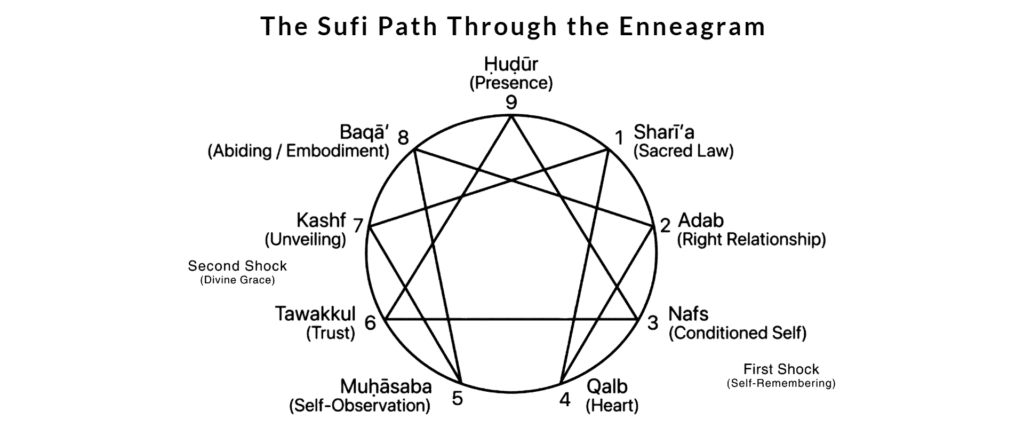
Establishing the Conditions for Transformation
Every process has prerequisites. Before transformation can occur, certain conditions must first be established, and the Enneagram suggests that the first three points create precisely those conditions. The question is whether the Sufi path unfolds according to the same sequence.
Point One: What Must Come First?
If transformation is lawful, it must begin with orientation. Every authentic process requires an organizing principle that exists prior to the individual who enters it because transformation cannot be invented according to personal preference; it must unfold according to laws that already exist.
This is exactly how the Sufi path begins. The seeker’s first movement is toward sharīʿa. Although commonly translated as “law,” its deeper meaning is the recognition that reality possesses an inherent order. The seeker’s task is not to create the path but to discover it, align with it, and allow that order to become the foundation for everything that follows. The correspondence is immediately apparent. The Enneagram begins by establishing lawful order, and so does Sufism.
Point Two: What Must Follow Law?
Law alone cannot transform anyone because knowing the principles of a path is not the same as participating in it. Once an organizing principle has been established, a lawful process requires relationship. The question, therefore, becomes how the individual enters relationship with the order established at Point One.
Sufism answers through adab. Although often translated as proper conduct or courtesy, adab reaches far beyond etiquette. It is the cultivation of the seeker’s relationship to every aspect of the path: teacher, practice, companions, and ultimately God. Humility, receptivity, sincerity, and respect are not simply admirable qualities; they are how the law becomes embodied rather than merely understood. Once again, the movement is coherent. What begins as lawful orientation naturally develops into conscious participation.
Point Three: What Is Being Transformed?
Having established law and relationship, the process arrives at another necessity: a lawful process cannot transform an abstraction; it must reveal the organization that has unconsciously governed experience from the beginning. Until that organization becomes visible, transformation can only produce more refined versions of the same underlying structure.
Here, Sufism introduces the nafs. More than instinct, desire, or what modern psychology would call the ego, the nafs is the organized sense of self through which memory, fear, attachment, ambition, imagination, and identity become woven into the experience of “I.” It quietly interprets every experience, including spiritual experience, in ways that preserve its continuity.
At this point, the coherence between the two systems becomes difficult to ignore. The first three points have not transformed the seeker; they have established the conditions under which transformation can genuinely begin. There is now a lawful order, a living relationship to that order, and a clear recognition of the organization that stands at the center of experience. The process has reached its first critical threshold because a self-organizing system cannot fundamentally reorganize itself. If the nafs cannot transform the nafs, then something entirely new must enter the process. Gurdjieff called this the first conscious shock, and it is here that the Sufi path begins to turn from the nafs toward the qalb, the heart.
Establishing the Conditions for Realization
The first three points established the conditions for transformation by revealing the nafs as the existing organization of experience. The next three points ask a different question: “If the nafs cannot transform itself, how does an entirely new mode of being emerge?” Once again, the Enneagram suggests that the process unfolds in a lawful sequence, and the question is whether the Sufi path follows that same movement.
Point Four: What Interrupts the Nafs?
The Enneagram places the first conscious shock between Points Three and Four because the process has reached the limits of what the existing organization can accomplish. However refined the nafs may become, it remains organized around itself. Something must interrupt that momentum if transformation is to continue.
Gurdjieff called this interruption self-remembering.
Self-remembering is not self-analysis or self-consciousness; it’s the direct recognition that awareness has become identified with the activity of the nafs. In the very act of remembering oneself, identification begins to loosen, and a new center of gravity becomes possible.
The Sufi path expresses this same movement through the awakening of the qalb, the heart. The heart is not simply the emotional center; it is the organ of direct knowing through which a new center of identity begins to emerge. As identification with the nafs weakens, the heart gradually becomes capable of perceiving reality without the constant distortions of conditioned identity. Self-remembering interrupts identification, while the heart becomes the new center through which reality is known.
There is another intriguing correspondence here. Gurdjieff described the first conscious shock as self-remembering, while Sufism places dhikr, remembrance of Allah, at the very center of its path. Whether or not Gurdjieff borrowed the phrase from the Sufi tradition remains an open historical question, but the structural relationship is difficult to ignore.
Perhaps the difference lies less in the act of remembering than in its emphasis. Gurdjieff begins by remembering oneself, thereby interrupting identification with the conditioned personality. Sufism begins by remembering Allah, allowing the heart to awaken through continual remembrance. Yet these movements may not be as different as they first appear. Self-remembering eventually raises a question it cannot itself answer: “Who or what is doing the remembering?” Likewise, the more deeply one remembers Allah, the more the illusion of a separate self dissolves. Both movements gradually weaken identification with the nafs and establish a new center of gravity from which realization can unfold.
Point Five: What Must Be Observed?
The first conscious shock establishes the heart as a new center of identity, but awakening alone cannot complete the process. Having discovered a new way of knowing, the seeker must now learn to live from it. Point Five marks the development of a new capacity: the ability to observe experience from the perspective of the heart rather than through the conditioned activity of the nafs.
The object of that observation is not merely the nafs, but the living relationship between the individual and reality as it is revealed through the heart. Every reaction, every attraction, every judgment, every fear, and every desire becomes an opportunity to observe how the nafs continues to interpret experience in accordance with its conditioning, while the qalb gradually discloses a different way of knowing. The heart does not judge the activity of the nafs; it illuminates it. As its influence deepens, the seeker begins to distinguish between experience organized by conditioned identity and experience arising from the direct perception of the heart.
Observation becomes increasingly phenomenological. Rather than only asking, “How is the nafs organizing my experience?” the seeker also begins to ask, “What does reality reveal when it is received through the heart?” The movement of Point Five is not simply toward greater self-understanding, but toward a growing participation in Reality as perceived by the awakened qalb.
The Sufi tradition expresses this movement through muhāsaba, self-accounting, together with continual vigilance over the movements of the heart. This is the careful observation of motives, assumptions, reactions, and intentions as they arise. The aim is not to condemn the nafs, but to understand its activity so clearly that it can no longer unconsciously occupy the center of experience.
Within this context, dhikr, the remembrance of Allah, assumes an even deeper significance; remembrance continually returns the heart to Reality while observation reveals everything that obscures that relationship. The two work together. Observation exposes the activity of the nafs; remembrance prevents the heart from becoming lost within it. Gradually, the seeker begins to experience life less through the conditioned interpretations of personality and more through the direct knowing of the awakened heart.
Self-remembering opens the way to the heart. The awakened heart observes the relationship between the individual and reality with increasing clarity, preparing the seeker for the surrender required at the second conscious shock.
Point Six: What Are the Limits of Personal Effort?
Every lawful process eventually reaches another threshold. Up to this point, discipline, observation, remembrance, and refinement have all been indispensable, yet each still carries a subtle assumption: that realization can ultimately be accomplished through personal effort. As observation deepens, however, another discovery gradually emerges. Reality cannot be controlled, possessed, or brought about through the activity of the nafs. The seeker arrives at the limits of personal will and stands before the uncertainty of not knowing what comes next.
This uncertainty is a necessary condition. As long as the seeker believes that realization can be achieved through greater effort, greater understanding, or greater discipline, the process remains organized around personal agency. Point Six reveals the limits of that assumption. What had previously been experienced as uncertainty gradually becomes openness, and what first appeared as the loss of control becomes the willingness to trust a Reality greater than oneself.
Sufism expresses this movement through tawakkul, trust in Allah. Trust does not eliminate uncertainty; it transforms one’s relationship to it. The seeker’s confidence gradually shifts from personal effort to Divine activity, discovering that the path has never been sustained by the individual alone. The will of the nafs begins to yield to the will of Allah, creating the receptive conditions through which the process can continue.
It is precisely here that the second conscious shock becomes possible. In Gurdjieff’s formulation, the active force represented by Point Three re-enters the process through Point Six. Only complete receptivity can receive a new activity. From the seeker’s perspective, this is experienced as grace. What could not be accomplished through personal striving is now accomplished through a deeper activity that does not originate in the personality. Surrender is therefore not the second shock; it is the openness that allows the second shock to occur. The receptive heart meets Divine activity, and the process moves beyond what personal effort alone could ever achieve.
Only then have the conditions for revelation been fully established.
Revelation, Embodiment, and Return
The first six points have prepared the conditions for realization:
- Law has established the path.
- Relationship has drawn the seeker into participation.
- The nafs has become visible.
- Self-remembering has interrupted identification.
- The heart has gradually become the new organizing principle.
- Complete receptivity has prepared the conditions for grace.
Point Seven: What Follows the Second Conscious Shock?
If the second conscious shock represents the relinquishing of personal will, then the next movement cannot be produced through effort. What emerges at Point Seven is not produced by the seeker but received through the action of grace.
Sufism describes this movement through kashf, unveiling. The truth is no longer approached indirectly through concepts, beliefs, or even disciplined practice; it reveals itself. The seeker does not acquire new information so much as awaken to a new mode of perception in which Reality becomes immediately present. What had previously been sought through effort is now encountered through direct knowing.
Once again, the correspondence is remarkable. The Enneagram predicts that revelation follows the second conscious shock, and Sufism describes precisely such a movement through unveiling.
Point Eight: How Does Revelation Become Life?
Revelation alone does not complete the process. A profound experience may transform a moment without transforming a life. If the Enneagram is describing a lawful process, then realization must become embodied. What has been revealed must gradually organize perception, relationship, work, and action until it becomes the ordinary ground from which life is lived.
Sufism expresses this movement through the return from fanāʾ, the dissolution of the separate self, to baqāʾ, abiding in God. The seeker does not disappear from the world but returns to it with a fundamentally different center of gravity. Action continues, relationships continue, responsibilities continue, yet they are no longer organized around the preservation of the nafs. The qualities traditionally associated with the realized human being—compassion, discernment, humility, generosity, and service—emerge naturally because they arise from a different source.
The teaching is no longer something the realized person possesses; it becomes something woven into the fabric of ordinary life, and is entirely consistent with the Enneagram; revelation becomes embodiment.
Point Nine: What Does the Process Return To?
Every lawful process completes a cycle by returning to equilibrium. The final point does not represent an ending as much as the establishment of a new beginning. The process returns to life, but it does not return as it left.
The Sufi path arrives at the same conclusion. The realized person does not withdraw permanently from ordinary existence. Rather, ordinary existence becomes the field in which realization is expressed. The marketplace, the family, the workshop, and the community all become places where the Divine is remembered and embodied. Throughout the Sufi world, carpet makers, basket weavers, potters, calligraphers, and other artisans have woven the wisdom of the path directly into the objects they created. Their work was never merely functional or decorative; it became a vehicle for transmitting remembrance, beauty, and spiritual teaching through the ordinary activities of daily life. Realization does not culminate in escaping the world, but in allowing the world to become an expression of what has been realized.
The equilibrium at Point Nine is profoundly different from the equilibrium at which the journey began. The first was organized around unconscious identification with the nafs. The second is organized around conscious participation in Reality. Outwardly, very little may appear to have changed. Inwardly, everything has changed because the center from which life is lived has been transformed.
Seen as a whole, the coherence between the Sufi path and Gurdjieff’s understanding of the Enneagram is difficult to dismiss. The path begins by establishing lawful order, develops through relationship, reveals the conditioned self, passes through the two indispensable shocks of self-remembering and the action of Divine grace, opens into revelation, becomes embodied in ordinary life, and finally returns to a new equilibrium. Whether these movements are described through the language of Sufism, Buddhism, the Diamond Approach, or another authentic contemplative tradition, the architecture remains strikingly consistent. Perhaps that is precisely what Gurdjieff intended when he described the Enneagram as a universal symbol of lawful process.