
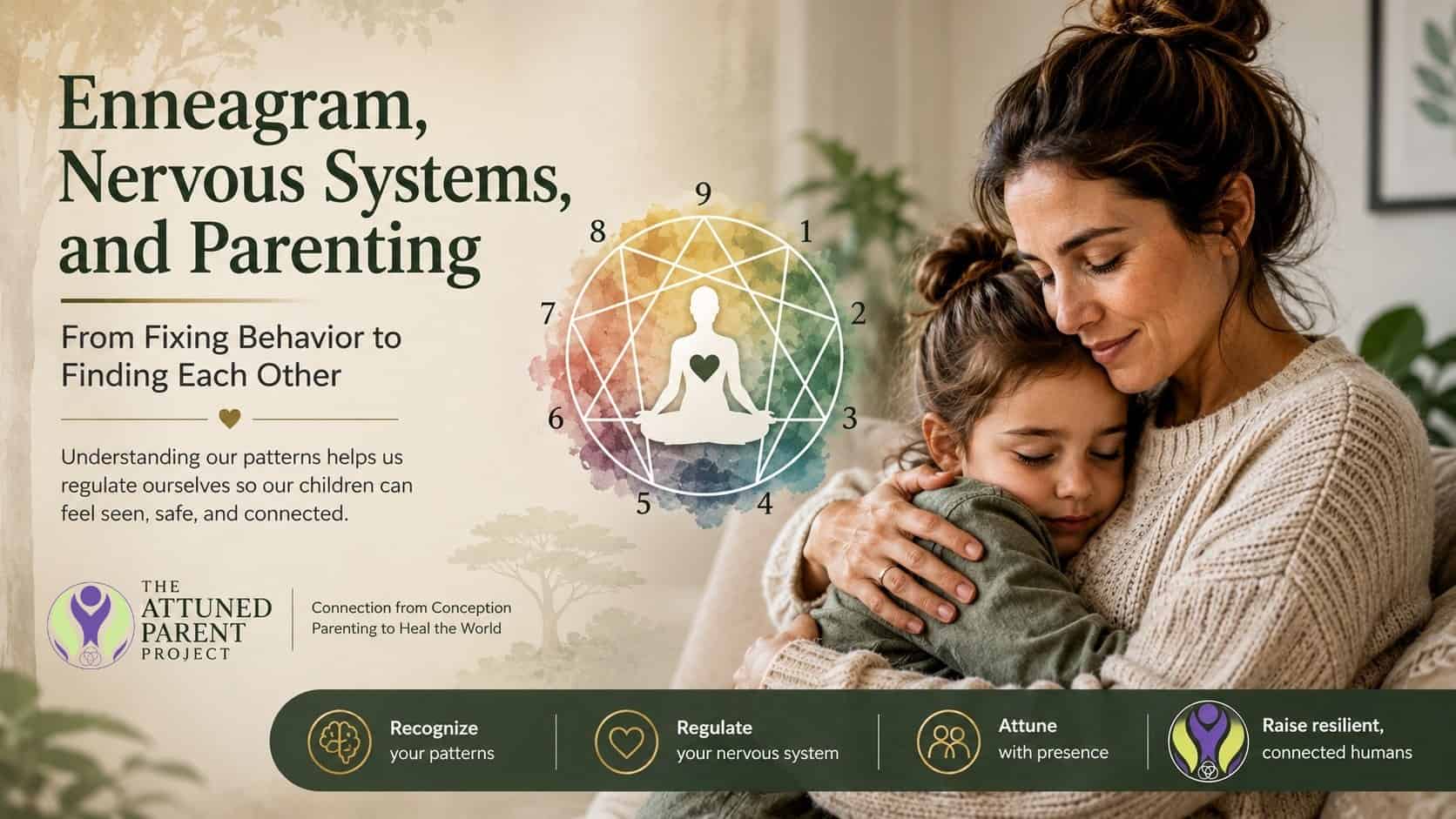
How the Attuned Parent Project Uses Self-Awareness to Build Secure Attachment
Parents often discover the Enneagram while looking for a better understanding of themselves or their children. Less widely recognized is that the Enneagram can also illuminate how the nervous system organizes itself under stress, particularly within the emotionally charged environment of family life. Viewed through this lens, the Enneagram becomes more than a personality typology. It becomes a practical framework for recognizing the automatic patterns that shape connection, conflict, and repair between parent and child.
The Attuned Parent Project (TAPP) builds upon this perspective by integrating the Enneagram with contemporary understanding of attachment, nervous system regulation, trauma, and child development. Rather than focusing on changing a child’s behavior, TAPP begins with the parent. It teaches caregivers to recognize their own habitual responses to stress, understand what those responses communicate to a developing child, and cultivate the presence that allows genuine attunement to emerge. This article explores how the Enneagram, nervous system science, and relational awareness converge to create a different model of parenting, one centered on connection rather than control.
What Is the Attuned Parent Project?
The Attuned Parent Project is an educational approach designed to help parents and caregivers develop greater self-awareness and build healthier relationships with their children. Its stated mission is to provide practical education, insights, and developmental tools that foster secure attachment, emotional resilience, and healthy human development.
Although TAPP incorporates the Enneagram, it is not used to classify children’s personalities. Instead, it serves as a language for understanding recurring patterns of perception, emotion, and behavior that emerge when individuals experience stress, uncertainty, or relational threat. When combined with principles drawn from attachment theory, trauma-informed care, developmental psychology, and nervous system regulation, the Enneagram becomes a guide for understanding why parents react as they do and how those reactions shape a child’s developing sense of safety.
This represents an important shift in emphasis. The central question is no longer, “What type of parent am I?” It becomes, “How does my nervous system organize itself when connection feels threatened, and how does that influence my child?”
Why the Nervous System Matters More Than Behavior
Much traditional parenting advice concentrates on behavior. Parents are encouraged to reduce tantrums, improve listening, establish consequences, and reinforce desirable actions. While these approaches have practical value, they often address the visible expression of a much deeper process.
Every behavior arises from an underlying state of the nervous system. A child who withdraws, becomes aggressive, clings to a parent, or refuses to cooperate is communicating something about their internal experience before they make a conscious decision about how to behave. Their body is revealing whether it experiences the world as safe, uncertain, overwhelming, or disconnected.
Parents are participating in exactly the same process. Adults often imagine that they are responding objectively to their children’s behavior, yet much of their own reaction originates from automatic physiological patterns shaped by earlier relationships, accumulated stress, and long-established survival strategies. Two parents may witness the identical situation and respond in entirely different ways because their nervous systems interpret the same event through different histories.
Seen from this perspective, parenting becomes less about controlling behavior and more about understanding the interaction between two nervous systems that are continually influencing one another.
A Different Way to Understand the Enneagram
The Enneagram is commonly presented as a system of personality types, emphasizing characteristic motivations, strengths, and blind spots. While valuable, this approach can unintentionally encourage people to identify with a fixed self-description.
Parenting reveals another possibility: Under stress, the Enneagram describes recurring patterns of nervous system organization rather than fixed aspects of identity. Each pattern represents a learned strategy for maintaining connection, reducing uncertainty, avoiding emotional pain, or restoring a sense of safety. These strategies were originally developed as intelligent adaptations to childhood circumstances. They are attempts to preserve relationship and emotional equilibrium using the resources available at the time.
This distinction changes how the Enneagram is used. Instead of asking, “Who am I?” parents begin asking, “What automatic strategy is becoming active right now?” The focus shifts from identity to awareness, from labels to observation, and from self-judgment to curiosity.
That shift is particularly valuable because parenting consistently activates the very relational patterns that the Enneagram describes.
Attunement Begins With Self-Awareness
TAPP defines attunement as being in tune with another person’s emotional experience. It describes attunement as an activated quality of presence through which a child feels seen, understood, accepted, mirrored, and emotionally safe.
Attunement cannot be manufactured through technique alone. A parent may know exactly what to say while their body communicates anxiety, irritation, withdrawal, or fear. Children, especially infants and young children, respond primarily to these nonverbal signals. Long before language develops, they are learning whether another nervous system feels stable enough to organize around.
This observation aligns with the work of developmental psychologists and attachment researchers who have shown that emotional regulation develops through repeated experiences of co-regulation. Children gradually acquire the capacity to regulate themselves because someone else’s nervous system consistently provides safety, steadiness, and responsiveness.
The quality of a parent’s presence, therefore, becomes more influential than the perfection of their parenting techniques.
How the Enneagram Supports Attunement
The Enneagram helps parents recognize the particular ways they move away from attunement when they become stressed.
One parent may respond by increasing control, structure, and correction in an effort to restore certainty. Another may withdraw emotionally, attempting to reduce stimulation or conflict. Someone else may become overly accommodating, anxiously trying to preserve harmony by ignoring their own needs. Each response makes sense within the history that produced it, yet each also influences how a child experiences relationship.
The value of the Enneagram is not that it predicts behavior with perfect accuracy. Its value lies in making these automatic patterns visible before they unconsciously direct the interaction.
Instead of concluding, “I’m failing as a parent,” caregivers can ask a different question: “What is my nervous system trying to accomplish right now?” That inquiry often reveals fear beneath anger, uncertainty beneath control, or exhaustion beneath withdrawal. Once those underlying states become conscious, greater flexibility becomes possible.
The child no longer encounters only the parent’s habitual defensive pattern. They encounter a parent who is becoming increasingly available.
From Managing Behavior to Reading Signals
One of TAPP’s most significant contributions is the shift from behavior management to nervous system literacy. Tantrums, defiance, emotional shutdown, clinginess, perfectionism, or impulsivity are no longer viewed solely as problems to be corrected. They become meaningful signals that invite understanding.
This perspective does not eliminate boundaries or consequences. Healthy structure remains essential for development. What changes is the parent’s interpretation of what behavior represents. A child’s outburst may reflect emotional overwhelm rather than deliberate defiance. Withdrawal may communicate uncertainty rather than rejection. Hyperactivity may reveal an activated nervous system attempting to restore equilibrium rather than intentional disruption.
Parents simultaneously learn to recognize when their own Enneagram patterns become activated by these signals. Instead of escalating into criticism, emotional distance, overprotection, or control, they gradually develop the capacity to pause, regulate themselves, and reconnect.
Repair becomes more important than perfection because every successful repair teaches the child that relationships can recover from difficulty.
Parenting Shapes Generations
One of TAPP’s guiding ideas is expressed in its phrase, “Connection from Conception.” The statement reflects a growing body of developmental research showing that repeated relational experiences influence the architecture of the developing brain and nervous system.
Children internalize far more than they do from explicit lessons. They absorb patterns of emotional regulation, conflict resolution, resilience, trust, and interpersonal safety through thousands of everyday interactions.
The Enneagram offers a way of recognizing the intergenerational transmission of these relational habits. Defensive strategies that once helped one generation survive can quietly become the emotional inheritance of the next. Greater self-awareness interrupts that transmission.
This is one reason parenting represents such profound developmental work. The transformation taking place within the parent becomes part of the developmental environment in which the child grows.
The Deeper Contribution of the Enneagram
The Enneagram’s greatest contribution to parenting may not be helping adults understand their personalities. It may be helping them recognize the difference between identity and adaptation.
Many of the patterns we experience as “who I am” began as intelligent responses to circumstances that no longer exist. Parenting continually exposes these patterns because children naturally evoke the deepest layers of attachment, vulnerability, and protection within their caregivers.
When those patterns become visible without self-condemnation, parents gain greater freedom to respond rather than react. They become more capable of offering presence rather than automatic defense, curiosity rather than judgment, and connection rather than control.
The result is not perfect parenting; it’s increasingly conscious parenting.
The Attuned Parent Project brings together the Enneagram, attachment theory, nervous system regulation, trauma-informed understanding, and developmental psychology into a coherent model of relational growth. Its central insight is remarkably simple: the most important work parents do is not changing their children but becoming increasingly aware of themselves.
Viewed in this way, the Enneagram is far more than a system of personality types. It becomes a map of recurring survival strategies that shape perception, emotion, and relationship. Understanding those strategies allows parents to recognize how they move away from connection under stress and how they can return with greater presence.
Children develop within relationships long before they understand explanations or discipline. Every moment of genuine attunement helps build the internal capacities for emotional regulation, trust, resilience, and secure attachment. The deepest gift a parent offers is therefore not flawless behavior management but a nervous system capable of meeting another human being with steadiness, awareness, and care.